Laiteron épineux
(Sonchus asper)


 |
**
-
*
|
**
-
*
Une herbe annuelle dressée. Il atteint 1 m de haut. Les tiges sont creuses. Il y a de la sève laiteuse lorsque les tiges sont coupées. Il y a des glandes sur les parties su ... (traduction automatique)
→suite


Laiteron épineux
Note alimentaire 
Note médicinale 

Une herbe annuelle dressée. Il atteint 1 m de haut. Les tiges sont creuses. Il y a de la sève laiteuse lorsque les tiges sont coupées. Il y a des glandes sur les parties supérieures. Les feuilles mesur... (traduction automatique) →suite
![Illustration Sonchus asper, Par Smith, J.E., English botany, or coloured figures of British plants, ed. 3 [B] [J.E. Sowerby et al] (1863-1899) Engl. Bot., ed. 3 vol. 5 (1866) t. 812, via plantillustrations](inc/images/illustrations/sonchus_asper.jpg)
Sonchus asper
Classification
- Classique : en haut de l'écran, sous le coeur.
- Phylogénétique :
- Clade 4 : Angiospermes ;
- Clade 3 : Dicotylédones_vraies ;
- Clade 2 : Astéridées ;
- Clade 1 : Campanulidées ;
- Ordre APN : Asterales ;
- Famille APN : Asteraceae ;
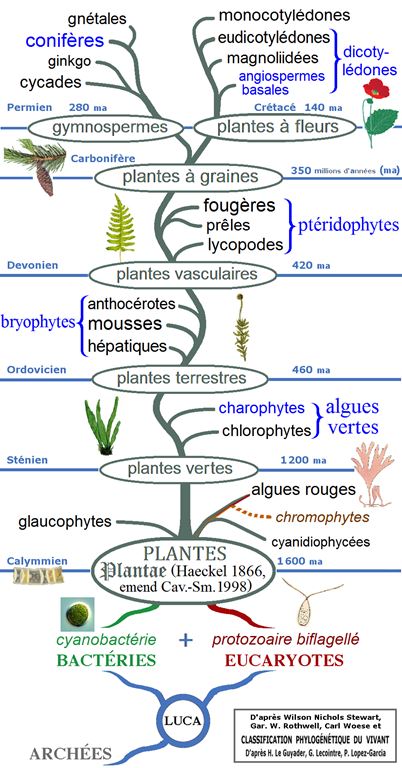
À droite, cet arbre phylogénétique des plantes montre les principaux clades et groupes traditionnels (monophylétiques en noir et paraphylétiques en bleu).
Dénominations
- Nom botanique : Sonchus asper (L.) Hill (1769)
- Synonymes français : laiteron rude, laiteron piquant
- Synonymes : Sonchus aemulus Merino, Sonchus asper All, Sonchus asper (L.) Vill, Sonchus australis Hort. ex Colla, Sonchus borderi Gand, Sonchus carolinianus Walter, Sonchus crocifolius Hort. ex Sch.Bip, Sonchus cuspidatus Blume, Sonchus decipiens (De Not.) Zenari, Sonchus eryngiifolius Sosn, Sonchus eryngioides DC, Sonchus fallax Wallr, Sonchus ferox Wall. [Invalid], Sonchus glaber Thunb, Sonchus infestus Poepp. ex DC, Sonchus oleraceus var. asper L, Sonchus spinosus Lam, Sonchus spinulosus Bigel, Sonchus sulphureus Boiss, Sonchus tibesticus Quezel, Sonchus umbellatus E. Mey. ex DC, Sonchus viridis Zenari
- Noms anglais et locaux : rough sowthistle, spiny sowthistle
Description et culture
Tableau récapitulatif
Parties comes-tibles Note comest. (1-5) Note medic. (1-5) (Zones de) Rusticité Besoins en 
Besoins en  (1-3)
(1-3)Périodes de semis et récoltes Graines au gramme Durée de viabilité Profon-deur semis Espace-ment plants Espace-ment lignes Durée germi-native Durée avant récolte Zones de rusticité : J F M A M J
J A S O N D
J F M A M J
J A S O N D
- dont infos de 0FPI ("FOOD PLANTS INTERNATIONAL", en anglais) :
Description :
Une herbe annuelle dressée. Il atteint 1 m de haut. Les tiges sont creuses. Il y a de la sève laiteuse lorsque les tiges sont coupées. Il y a des glandes sur les parties supérieures. Les feuilles mesurent 5 à 15 cm de long. Les feuilles enserrent à moitié la tige. Ils ont des structures en forme d'oreille arrondies à la base. Les bords peuvent être épineux ou avoir des dents. Les plantes sont vert bleuâtre. Les capitules sont jaunes. Ils mesurent 1 à 2 cm de diamètre. Ils sont entassés en têtes irrégulières. Le fruit est un fruit sec{{{0(+x) (traduction automatique).
Original : An erect annual herb. It grows to 1 m high. The stems are hollow. There is milky sap when the stems are cut. There are some glands on the upper parts. The leaves are 5-15 cm long. The leaves half clasp the stem. They have rounded ear like structures at the base. The edges can be spiny or have teeth. The plants are bluish-green. The flower heads are yellow. They are 1-2 cm across. They are crowded in irregular heads. The fruit is a dry fruit{{{0(+x).
Culture :
Les plantes sont cultivées à partir de graines{{{0(+x) (traduction automatique).
Original : Plants are grown from seed{{{0(+x).
 Consommation (rapports de comestibilité, parties utilisables et usages alimentaires correspondants)
Consommation (rapports de comestibilité, parties utilisables et usages alimentaires correspondants)Feuille (tendres ; tiges)1, fleur1 et racine1 comestibles.
Partie testée :
feuilles{{{0(+x) (traduction automatique). Original : Leaves{{{0(+x)| Taux d'humidité (%) | Énergie (kj) | Énergie (kcal) | Protéines (g) |
|---|---|---|---|
| 0.9 | 111 | 27 | 27 3.3 |
| Pro- vitamines A (µg) |
Vitamines C (mg) | Fer (mg) | Zinc (mg) |
| 0 | 63.0 | 111 3.0 | 0.9 |
 Risques et précautions à prendre
Risques et précautions à prendrenéant, inconnus ou indéterminés.
Galerie(s)
Par Smith, J.E., English botany, or coloured figures of British plants, ed. 3 [B] [J.E. Sowerby et al] (1863-1899) Engl. Bot., ed. 3 vol. 5 (1866) t. 812, via plantillustrations
✖

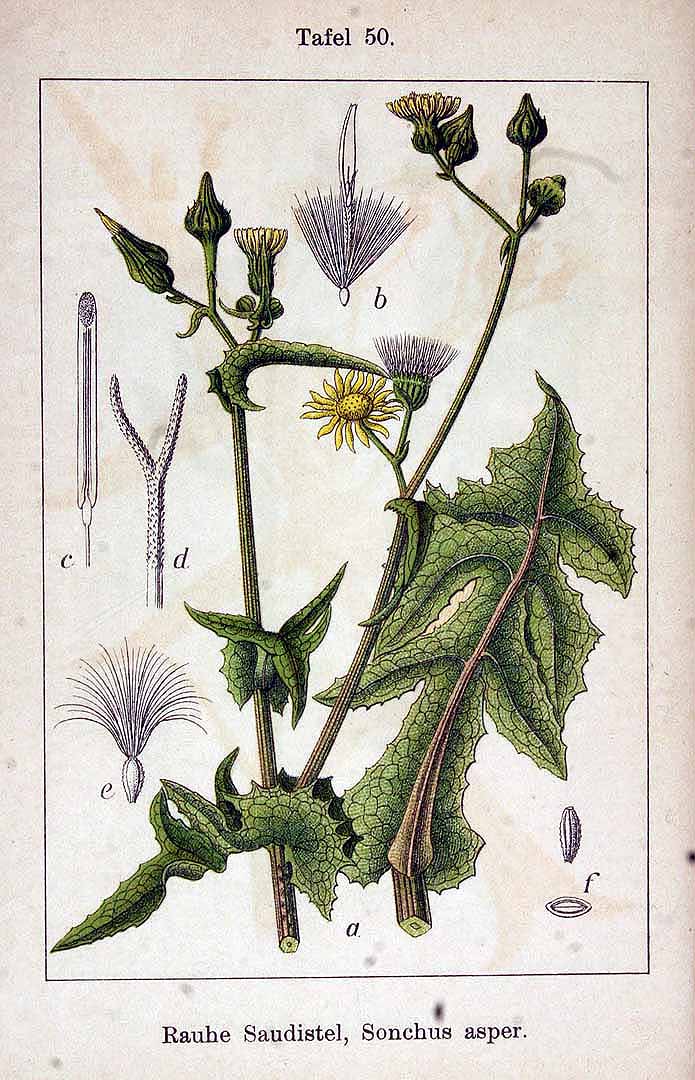
Par Sturm, J., Krause, E.H.L., Lutz, K.G., Flora von Deutschland in Abbildungen nach der Natur, Zweite auflage (1900-1907) Deutschl. Fl., ed. 2 vol. 14 (1906) t. 50, via plantillustrations
✖

Autres infos
dont infos de 0FPI ("FOOD PLANTS INTERNATIONAL", en anglais) :
Statut :
C'est un légume mineur{{{0(+x) (traduction automatique).
Original : It is a minor vegetable{{{0(+x).
Distribution :
Il pousse dans les régions tempérées et subtropicales. Au Népal, les plantes poussent entre 1000 et 1800 m d'altitude. Ils poussent sur un sol humide et négligé. Il convient aux sols sableux. En Afrique, il pousse entre 750 et 2 550 m d'altitude. En Argentine, il passe du niveau de la mer à 2500 m d'altitude. Herbier de Tasmanie{{{0(+x) (traduction automatique).
Original : It grows in temperate and subtropical regions. In Nepal plants grow between 1000-1800 m altitude. They grow on moist, neglected ground. It suits sandy soils. In Africa it grows between 750-2,550 m above sea level. In Argentina it grows from sea level to 2,500 m above sea level. Tasmania Herbarium{{{0(+x).
Localisation :
Afghanistan, Afrique, Argentine, Asie, Australie, Bahamas, Bahreïn, Bhoutan, Bolivie, Botswana, Brésil, Grande-Bretagne, Burkina Faso, Canada, Chili, Chine, Croatie, République dominicaine, Afrique de l'Est, Île de Pâques, Eswatini, Europe *, Malouines , France, Grèce, Guyane, Haïti, Hawaï, Himalaya, Inde, Indochine, Indonésie, Italie, Jamaïque, Japon, Kazakhstan, Corée, Kirghizistan, Madagascar, Malawi, Méditerranée, Maroc, Mozambique, Népal, Nouvelle-Guinée, Nouvelle-Zélande, Nord Afrique, Amérique du Nord, Inde du Nord-Est, Pacifique, Pakistan, Paraguay, Portugal, Porto Rico, Qatar, Russie, Rwanda, Arabie Saoudite, Scandinavie, Asie du Sud-Est, Slovénie, Afrique du Sud, Amérique du Sud, Afrique australe, Espagne, Swaziland, Taiwan, Tadjikistan, Tasmanie, Thaïlande, Tibet, Tonga, Turquie, Turkménistan, Uruguay, USA, Ouzbékistan, Venezuela, Vietnam, Antilles, Zambie, Zimbabwe{{{0(+x) (traduction automatique).
Original : Afghanistan, Africa, Argentina, Asia, Australia, Bahamas, Bahrain, Bhutan, Bolivia, Botswana, Brazil, Britain, Burkina Faso, Canada, Chile, China, Croatia, Dominican Republic, East Africa, Easter Island, Eswatini, Europe*, Falklands, France, Greece, Guyana, Haiti, Hawaii, Himalayas, India, Indochina, Indonesia, Italy, Jamaica, Japan, Kazakhstan, Korea, Kyrgyzstan, Madagascar, Malawi, Mediterranean, Morocco, Mozambique, Nepal, New Guinea, New Zealand, North Africa, North America, Northeastern India, Pacific, Pakistan, Paraguay, Portugal, Puerto Rico, Qatar, Russia, Rwanda, Saudi Arabia, Scandinavia, SE Asia, Slovenia, South Africa, South America, Southern Africa, Spain, Swaziland, Taiwan, Tajikistan, Tasmania, Thailand, Tibet, Tonga, Turkey, Turkmenistan, Uruguay, USA, Uzbekistan, Venezuela, Vietnam, West Indies, Zambia, Zimbabwe{{{0(+x).
Notes :
Il existe environ 60 espèces de Sonchus{{{0(+x) (traduction automatique).
Original : There are about 60 Sonchus species{{{0(+x).
Rusticité (résistance face au froid/gel, climat)
Zones de rusticité :
Liens, sources et/ou références
Liens :
Wikipedia ;Sources et/ou références :
bibliographie (liste des sources et/ou références de l'encyclopédie)
dont classification : TPL ("The Plant List", en anglais) ; Tela Botanica ;
dont livres et bases de données : 5PFAF ("Plants For A Future", en anglais) ; 1Plantes sauvages comestibles (livre pages 144 et 145, par S.G. Fleischhauer, J. Guthmann et R. Spiegelberger) ; 1Plantes sauvages comestibles (de S.G. Fleischhauer, J. Guthmann et R. Spiegelberger, éditions Ulmer, 2012) / détails du livre ; 88Sauvages & comestibles - herbes, fleurs et petites salades (de Marie-Claude Paume, éditions EDISUB, 2011) / détails du livre
dont bibliographie/références de 0FPI ("FOOD PLANTS INTERNATIONAL", en anglais) :
Ambasta, S.P. (Ed.), 2000, The Useful Plants of India. CSIR India. p 584 ; Beckstrom-Sternberg, Stephen M., and James A. Duke. "The Foodplant Database."http://probe.nalusda.gov:8300/cgi-bin/browse/foodplantdb.(ACEDB version 4.0 - data version July 1994) ; Bhattarai, S and Chaudary, R. P., 2009, Wild Edible Plants Used by the People of Manang District, Central Nepal. Ecology of Food and Nutrition, 48:1-20 ; Biscotti, N. & Pieroni, A., 2015, The hidden Mediterranean diet: wild vegetables traditionally gathered and consumed in the Gargano area, Apulia, SE Italy. Acta Societatis Botanicorum Poloniae 84 (3): 327-338 ; Biscotti, N. et al, 2018, The traditional food use of wild vegetables in Apulia (Italy) in the light of Italian ethnobotanical literature. Italian Botanist 5:1-24 ; Blamey, M and Grey-Wilson, C., 2005, Wild flowers of the Mediterranean. A & C Black London. p 466 ; Brit. herb. 47. 1756 ; Cherikoff V. & Isaacs, J., The Bush Food Handbook. How to gather, grow, process and cook Australian Wild Foods. Ti Tree Press, Australia p 196 ; Cribb, A.B. & J.W., 1976, Wild Food in Australia, Fontana. p 129 ; Crowe, A., 1997, A Field Guide to the Native Edible Plants of New Zealand. Penguin. p 99 ; Curtis, W.M., 1963, The Students Flora of Tasmania Vol 2 p 390 ; Dashorst, G.R.M., and Jessop, J.P., 1998, Plants of the Adelaide Plains & Hills. Botanic Gardens of Adelaide and State Herbarium. p 152 ; Diaz-Betancourt, M., et al, 1999, Weeds as a future source for human consumption. Rev. Biol. Trop. 47(3):329-338) ; Dolina, K. & Luczaj, L., 2014, Wild food plants used on the Dubrovnik coast (south-eastern Croatia) Acta Soc Bot Pol 83(3):175–181 ; Duke, J.A., 1992, Handbook of Edible Weeds. CRC Press. p 186 ; Ertug, F, Yenen Bitkiler. Resimli Türkiye Florası -I- Flora of Turkey - Ethnobotany supplement ; Facciola, S., 1998, Cornucopia 2: a Source Book of Edible Plants. Kampong Publications, p 42 ; Flora of Australia Volume 49, Oceanic Islands 1, Australian Government Publishing Service, Canberra. (1994) p 372 ; Gangwar, A. K. & Ramakrishnan, P. S., 1990, Ethnobotanical Notes on Some Tribes of Arunachal Pradesh, Northeastern India. Economic Botany, Vol. 44, No. 1 pp. 94-105 ; Gott, B & Conran, J., 1991, Victorian Koorie Plants. PO Box 666 Hamilton, Victoria 3300, Australia. p 41 ; Grubben, G. J. H. and Denton, O. A. (eds), 2004, Plant Resources of Tropical Africa 2. Vegetables. PROTA, Wageningen, Netherlands. p 511 ; Hadjichambis, A. C., et al, 2007, Wild and semi-domesticated food plant consumption in seven circum-Mediterranean areas. International Journal of Food Sciences and Nutrition. 2007, 1-32. ; Harris, S., Buchanan, A., Connolly, A., 2001, One Hundred Islands: The Flora of the Outer Furneaux. Tas Govt. p 231 ; http://www.botanic-gardens-ljubljana.com/en/plants ; Hussey, B.M.J., Keighery, G.J., Cousens, R.D., Dodd, J., Lloyd, S.G., 1997, Western Weeds. A guide to the weeds of Western Australia. Plant Protection Society of Western Australia. p 106 ; Hyde-Wyatt, B.H. & Morris D.I., 1975, Tasmanian Weed Handbook. Dept of Ag Tasmania. p 35 ; Irving, M., 2009, The Forager Handbook, A Guide to the Edible Plants of Britain. Ebury Press p 159 ; Jardin, C., 1970, List of Foods Used In Africa, FAO Nutrition Information Document Series No 2.p 104 ; Kang, Y., et al, 2012, Wild food plants and wild edible fungi in two valleys on the Qinling Mountains (Shaanxi, central China) Journal of Ethnobiology and Ethnomedicine; 9:26 ; Kargioglu, M. et al, 2010, Traditional Uses of Wild Plants in the Middle Aegean Region. Human Ecology 38:429-450 ; Kayabasi, N. P., et al, 2018, Wild edible plants and their traditional use in the human nutrition in Manyas (Turkey). Indian Journal of Traditional Knowledge. Vol. 17(2), April 2018, pp 299-306 ; Kiple, K.F. & Ornelas, K.C., (eds), 2000, The Cambridge World History of Food. CUP p 1855 ; Lazarides, M. & Hince, B., 1993, Handbook of Economic Plants of Australia, CSIRO. p 224 ; Lentini, F. and Venza, F., 2007, Wild food plants of popular use in Sicily. J Ethnobiol Ethnomedicine. 3: 15 ; Low, T., 1991, Wild Herbs of Australia and New Zealand. Angus & Robertson. p 33 ; Luczaj, L. et al, 2012, Wild food plant use in 21st century Europe: the disappearance of old traditions and the search for new cuisines involving wild edibles. Acta Soc Bot Pol 81(4):359–370 ; MacKinnon, A., et al, 2009, Edible & Medicinal Plants of Canada. Lone Pine. p 333 ; Malezas Comestibles del Cono Sur, INTA, 2009, Buernos Aires ; Manandhar, N.P., 2002, Plants and People of Nepal. Timber Press. Portland, Oregon. p 433 ; Martin, F.W. & Ruberte, R.M., 1979, Edible Leaves of the Tropics. Antillian College Press, Mayaguez, Puerto Rico. p 186 ; Michael, P., 2007, Edible Wild Plants and Herbs. Grub Street. London. p 224 ; Moerman, D. F., 2010, Native American Ethnobotany. Timber Press. p 537 ; Nassif, F., & Tanji, A., 2013, Gathered food plants in Morocco: The long forgotten species in Ethnobotanical Research. Life Science Leaflets 3:17-54 ; Nebel, S., Pieroni, A. & Heinrich, M., 2006, Ta cho`rta: Wild edible greens used in the Graecanic area in Calabria, Southern Italy. Appetite 47 (2006) 333–342 ; Neogi, B., Prasad, M. N. V. and Rao, R. R., 1989, Ethnobotany of Some Weeds of Khasi and Garo Hills, Meghalaya, Northeastern India. Economic Botany 43(4): 471-479 ; Norton, J., et al, 2009, An Illustrated Checklist of the Flora of Qatar. UNESCO Office in Doha. ; Ochse, J.J. et al, 1931, Vegetables of the Dutch East Indies. Asher reprint. p 142 ; Paczkowska, G. & Chapman, A.R., 2000, The Western Australian Flora. A Descriptive Catalogue. Western Australian Herbarium. p 176 ; Paoletti, M.G., Dreon, A.L., and Lorenzoni, G.G., 1995, Pistic, Traditional Food from Western Friuli, NE Italy. Economic Botany 49(1) pp 26-30 ; Pickering, H., & Roe, E., 2009, Wild Flowers of the Victoria Falls Area. Helen Pickering, London. p 40 ; Pieroni, A., 1999, Gathered wild food plants in the Upper Valley of the Serchio River (Garfagnana), Central Italy. Economic Botany 53(3) pp 327-341 ; Plants for a Future database, The Field, Penpol, Lostwithiel, Cornwall, PL22 0NG, UK. http://www.scs.leeds.ac.uk/pfaf/ ; Plants of Haiti Smithsonian Institute http://botany.si.edu ; Sansanelli, S., et al, 2014, Wild food plants traditionall consumed in the area of Bologna (Emilia Romagna region, Italy). Journal of Ethnobiology and Ethnomedicine 10:69 ; Singh, B., et al, 2012, Wild edible plants used by Garo tribes of Nokrek Biosphere Reserve in Meghalaya, India. Indian Journal of Traditional Knowledge. 11(1) pp 166-171 ; Skinner, G. & Brown, 1981, C., Simply Living. A gatherer's guide to New Zealand's fields, forests and shores. Reed. p 23 ; Swaziland's Flora Database http://www.sntc.org.sz/flora ; Tasmanian Herbarium Vascular Plants list p 14 ; Tardio, J., et al, Ethnobotanical review of wild edible plants in Spain. Botanical J. Linnean Soc. 152 (2006), 27-71 ; Terra, G.J.A., 1973, Tropical Vegetables. Communication 54e Royal Tropical Institute, Amsterdam, p 76 ; Thakur, D., et al, 2017, Why they eat, what they eat: patterns of wild edible plants consumption in a tribal area of Western Himalaya. Journal of Ethnobiology and Ethnomedicine (2017) 13:70 ; Upson, R., & Lewis R., 2014, Updated Vascular Plant Checklist and Atlas for the Falkland Islands. Falklands Conservation and Kew. ; Vernon, R., 1983, Field Guide to Important Arable Weeds of Zambia. Dept of Agriculture, Chilanga, Zambia. p 94 ; Wehmeyer, A. S, 1986, Edible Wild Plants of Southern Africa. Data on the Nutrient Contents of over 300 species ; Yuncker, T.G., 1959, Plants of Tonga, Bernice P. Bishop Museum, Hawaii, Bulletin 220. p 270 ; Zizka, G., 1991, Flowering Plants of Easter Island. Palmarum Hortus Francofurtensis
Recherche de/pour :
- "Sonchus asper" sur Google (pages et
images) ;
IPNI ("International Plant Names Index", en anglais) ;
GRIN ("Germplasm Resources Information Network", en anglais) ;
TROPICOS (en anglais) ;
Pl@ntNet ;
Pl@ntUse ;
"Useful Tropical Plants" (en anglais) ou
"Useful Temperate Plants" (en anglais) ;
- "Laiteron épineux" sur Google (pages, images et recettes) ;
- "Sonchus asper" sur Google (pages et
images) ;
IPNI ("International Plant Names Index", en anglais) ;
GRIN ("Germplasm Resources Information Network", en anglais) ;
TROPICOS (en anglais) ;
Pl@ntNet ;
Pl@ntUse ;
"Useful Tropical Plants" (en anglais) ou
"Useful Temperate Plants" (en anglais) ;
Espèces du même genre (Sonchus)
22 taxons
- Laiteron
- Laiteron bulbeux des Baléares
- Laiteron délicat
- Laiteron des champs
- Laiteron maraîcher
- Laiteron maritime
- Sonchus arvensis L. (Laiteron des champs)
- Sonchus bipontini Asch.
- Sonchus brachyotus DC.
- Sonchus bulbosus (Laiteron bulbeux des Baléares)
- Sonchus crassifolius Pourr. ex Willd.
- Sonchus dregeanus DC.
- Sonchus exauriculatus O.Hoffm.
- Sonchus integrifolius Harv.
- Sonchus kirkii Hamlin
- Sonchus lingianus C.Shih
- Sonchus luxurians
- Sonchus maritimus Pall. ex Ledeb. (Laiteron maritime)
- Sonchus megalocarpa
- Sonchus nanus O.Hoffm.
- Sonchus oleraceus L. (Laiteron maraîcher)
- Sonchus pinnatifidus Lag. ex DC. (Laiteron)
- Sonchus schweinfurthii Oliv. & Hiern
- Sonchus sp
- Sonchus tenerrimus Schur (Laiteron délicat)
- Sonchus wightianus DC.
- Sonchus wilmsii R.E.Fr.
Espèces de la même famille (Asteraceae)
1403 taxons
- Absinthe
- Accipitrine
- Accoub de Syrie
- Achillée
- Achillée à boucliers
- Achillée à feuilles de Fougère
- Achillée compacte
- Achillée de Ligurie
- Achillée de Neilreich
- Achillée de Sibérie
- Achillée millefeuille
- Achillée musquée
- Achillée noirâtre
- Achillée ptarmique
- Achillée visqueuse
- Acmelle
- Ambroise à feuilles d'Armoise
- Ambroisie maritime
- Ambroisie trifide
- Anacycle de Valence
- Anacycle tomenteux
- Andryale
- Andryale à feuilles entières
- Andryale de Raguse
- Anthémis
- Anthémis de Chios
- Anthémis du mont Parnasse
- Anthémis fétide (traduction du latin "Anthemis foe
- Anthémis géante
- Anthémis précoce
- Aposeris (aposéris)
- Arctothèque
- Argyranthème
- Argyranthème nain
- Armérie vêtue
- Armoise à balais
- Armoise à pétioles rouges
- Armoise africaine
- Armoise annuelle
- Armoise arborescente
- Armoise bisannuelle
- Armoise blanche de chine
- Armoise camphrée
- Armoise champêtre
- Armoise commune
- Armoise d'Argy
- Armoise d'Autriche
- Armoise de la mer Noire
- Armoise de Saint-Louis
- Armoise des Frères Verlot
- Aaronsohnia factorovskyi Warb. & Eig
- Aaronsohnia pubescens (Fausse-Cotule pubescente)
- Acanthospermum hispidum DC. (Herbe-tricorne commune)
- Achillea ageratum L. (Achillée visqueuse)
- Achillea alpinaa
- Achillea arabica Kotschy (Achillée)
- Achillea atrata L. (Achillée noirâtre)
- Achillea borealis Bong.
- Achillea clavennae L. (Achillée)
- Achillea clypeolata Sm. (Achillée à boucliers)
- Achillea coarctata Poir. (Achillée compacte)
- Achillea decolorans Schrad. ex Willd.
- Achillea erba-rotta All. (Achillée musquée)
- Achillea filipendulina Lam. (Achillée à feuilles de Fougère)
- Achillea ligustica Vis. ex Nyman (Achillée de Ligurie)
- Achillea millefolium L. (Achillée millefeuille)
- Achillea nana L. (Faux Génépi)
- Achillea nobilis L. (Achillée de Neilreich)
- Achillea ptarmica L. (Achillée ptarmique)
- Achillea sibirica Ledeb. (Achillée de Sibérie)
- Achillea tenuifolia Salisb.
- Achillea teretifolia Willd.
- Achillea vermicularis Trin.
- Achyrachaena mollis Schauer
- Achyrocline alata
- Achyrocline satureioides (Lam.) DC.
- Acilepis aspera
- Acmella alba (L'Hér.) R.K.Jansen
- Acmella brachyglossa Cass.
- Acmella calva
- Acmella caulirhiza Delile (Acmelle)
- Acmella ciliata (Kunth) Cass.
- Acmella decumbens
- Acmella oleracea (L.) R.K. Jansen (Brède mafane)
- Acmella oppositifolia (Lam.) R.K.Jansen
- Acmella paniculata (Wall. ex DC.) R.K.Jansen
- Acmella uliginosa (Sw.) Cass.
- Acnistus arborescens (L.) Schltdl.
- Actinella odorata A.Gray
- Adenocaulon himalaicum Edgew.
- Adenostemma lavenia
- Adenostemma viscosum J.R.Forst. & G.Forst.
- Adenostoma sparsifolium Torr.
- Aetheorhiza bulbosa
- Ageratina adenophora (Eupatoire glanduleuse)
- Ageratina aromatica
- Ageratina sternbergiana
- Agoseris aurantiaca
- Agoseris glauca
- Agoseris villosa Rydb.
- ...
Par Sturm, J., Krause, E.H.L., Lutz, K.G., Flora von Deutschland in Abbildungen nach der Natur, Zweite auflage (1900-1907) Deutschl. Fl., ed. 2 vol. 14 (1906) t. 50, via plantillustrations







 donne accès au menu
  - encyclopédies des plantes alimentaires ;
 - page de recherche - reconnaissance (identification) de plantes ;
 - page du calendrier lunaire et son générateur (au format PDF et JPG) ;
 - tableau récapitulatif ;
 - générateur de potées (soupes), avec estimation des apports nutrionnels et du coût;
 - générateur de codes QR ;
 - page des archives avec de nombreux documents sur différents thèmes complémentaires comme la botanique, les légumes,
les champignons, la cuisine, le bien-être ainsi que différents MOOC mais également des liens vers les archives de l'association ;
- page des archives avec de nombreux documents sur différents thèmes complémentaires comme la botanique, les légumes,
les champignons, la cuisine, le bien-être ainsi que différents MOOC mais également des liens vers les archives de l'association ;

 pour le fruit (et/ou les graines, la pulpe, etc...),
 pour les fleurs (et/ou pétales, calice...),
 pour les feuilles (et/ou la tige, les pousses...),
 pour les racines,
 pour le tronc (et/ou l'écorce, la sève...), et enfin
 pour les champignons,
puis les notes alimentaires et médicinales (de 1 à 5 étoiles), la rusticité (résistance au froid/gel)
et pour finir un résumé.
pour les champignons,
puis les notes alimentaires et médicinales (de 1 à 5 étoiles), la rusticité (résistance au froid/gel)
et pour finir un résumé. menant ici 🙂
 ,
,  et
et





 ,
,


 Encyclopédie(s)
 Recherche-Reconnaissance
 Tableau récapitulatif
 Codes QR
 Archives
 Calendrier(s) lunaire(s)
  Potées
 Re-naturation/naturalisation
 Affichettes, herbiers &
co.
Affichettes, herbiers &
co. menu
menu galerie


 (en bas à droite).
 (en bas à gauche).
