
Sarrasin de Tartarie
(Fagopyrum tataricum)


 |
***
-
*
|
***
-
*
Une herbe annuelle. Il atteint 100 cm de haut. Les feuilles supérieures ont de longues tiges. Les feuilles mesurent de 2,5 à 12 cm de long sur 2,5 à 11,5 cm de large. Ils s ... (traduction automatique)
→suite

Sarrasin de Tartarie
Note alimentaire 
Note médicinale 

Une herbe annuelle. Il atteint 100 cm de haut. Les feuilles supérieures ont de longues tiges. Les feuilles mesurent de 2,5 à 12 cm de long sur 2,5 à 11,5 cm de large. Ils sont de forme largement triangulaire. Les fleurs sont roses ou blanches. Le fruit est sec et avec une graine. Il est rainuré. Il existe plusieurs... (traduction automatique) →suite
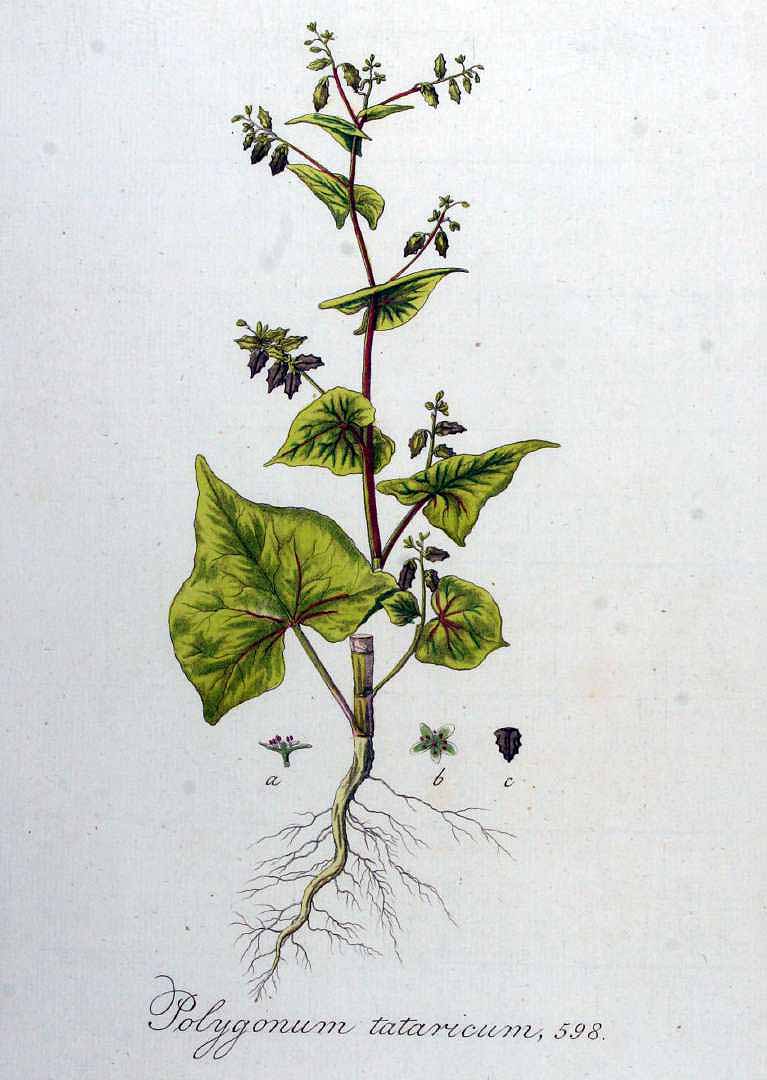
![Illustration Fagopyrum tataricum, Par Oeder, G.C., Flora Danica (1761-1861) Fl. Dan. vol. 15 (1852-1861) [tt. 2521-2700] t. 2649, via plantillustrations](inc/images/illustrations/fagopyrum_tataricum.jpg)
Classification
- Classique : en haut de l\'écran, sous le coeur.
- Phylogénétique :
- Clade 4 : Angiospermes ;
- Clade 3 : Dicotylédones_vraies ;
- Ordre APN : Caryophyllales ;
- Famille APN : Polygonaceae ;
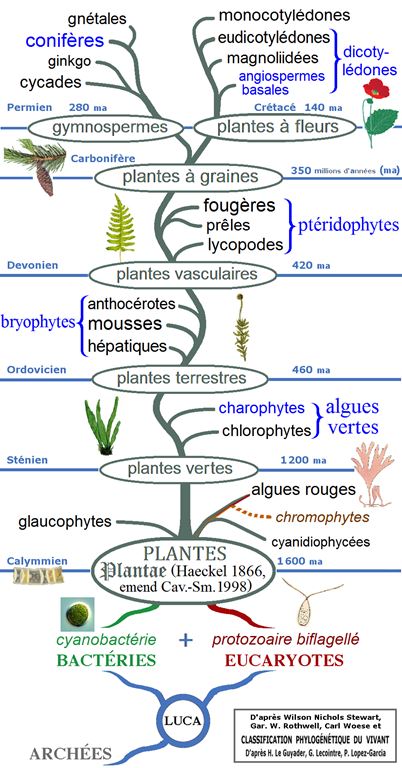
Illustration : cet arbre phylogénétique des plantes montre les principaux clades et groupes traditionnels (monophylétiques en noir et paraphylétiques en bleu).
Dénominations
✖- Nom botanique : Fagopyrum tataricum (L.) Gaertn. (1790)
- Synonymes français : blé de Tartarie, renouée de Tartarie
- Synonymes : Polygonum tataricum L
Dont basionyme : Polygonum tataricum L. 1753 ; - Noms anglais et locaux : duckwheat, green buckwheat, India buckwheat, India-wheat, Tartary buckwheat, Indian wheat (eu), Siberian buckwheat (eu), Tartarian buckwheat, ku chiao mai (cn transcrit), ku qiao (cn transcrit), tatarischer Buchweizen (de), kaspat (in,hi), grano saraceno siberiano (it), gre?icha tatarskaja (ru translittéré), tatarka (ru translittéré), alforfón de Tartaria (es), sibiriskt bovete (sv)
Description et culture
✖- dont infos de "FOOD PLANTS INTERNATIONAL" :
Description :
Une herbe annuelle. Il atteint 100 cm de haut. Les feuilles supérieures ont de longues tiges. Les feuilles mesurent de 2,5 à 12 cm de long sur 2,5 à 11,5 cm de large. Ils sont de forme largement triangulaire. Les fleurs sont roses ou blanches. Le fruit est sec et avec une graine. Il est rainuré. Il existe plusieurs variétés cultivées nommées{{{0(+x) (traduction automatique).
Original : An annual herb. It grows to 100 cm high. The upper leaves have long stalks. The leaves are 2.5-12 cm long by 2.5-11.5 cm wide. They are broadly triangular shape. The flowers are pink or white. The fruit is dry and with one seed. It is grooved. There are several named cultivated varieties{{{0(+x).
Culture :
Les plantes sont cultivées à partir de graines{{{0(+x) (traduction automatique).
Original : Plants are grown from seed{{{0(+x).
 Consommation (rapports de comestibilité, parties utilisables et usages alimentaires correspondants)
✖
Feuilles, graines{{{0(+x). Graines0(+x),27(+x) broyées0(+x) source d'une farine0(+x),{{{27(+x) ; la farine peut être mangée crue ; elle est également utilisée pour le pain.
Les graines sont également grillées.
Les graines donnent aussi une huile comestible.
Les feuilles sont aussi comestibles ; elles sont cuites{{{0(+x) (ex. : comme potherbe ? (qp*)).
Partie testée :
feuilles - poids sec{{{0(+x) (traduction automatique). Original : Leaves - dry wt{{{0(+x)| Taux d'humidité | Énergie (kj) | Énergie (kcal) | Protéines (g) |
|---|---|---|---|
| / | 24 | 6 | / |
| Pro- vitamines A (µg) |
Vitamines C (mg) | Fer (mg) | Zinc (mg) |
| / | / | / | / |
 Risques et précautions à prendre
✖
néant, inconnus ou indéterminés.
Galerie(s)
✖![Illustration Fagopyrum tataricum, Par Oeder, G.C., Flora Danica (1761-1861) Fl. Dan. vol. 15 (1852-1861) [tt. 2521-2700] t. 2649, via plantillustrations](inc/images/illustrations/fagopyrum_tataricum.jpg )


Autres infos
✖Plante cultivée de tout temps dans la zone d'origine{{{27(+x).
Statut :
C'est une plante alimentaire cultivée. Il est vendu sur les marchés locaux{{{0(+x) (traduction automatique).
Original : It is a cultivated food plant. It is sold in local markets{{{0(+x).
Distribution :
C'est une plante subtropicale. Il est plus tolérant à la sécheresse et au froid que le sarrasin normal. Au Népal, il pousse entre 1400-3000 m d'altitude. Il pousse dans des endroits ouverts. Dans l'Uttar Pradesh, il pousse entre 1800 et 3500 m d'altitude. Au Sichuan. Au Yunnan{{{0(+x) (traduction automatique).
Original : It is a subtropical plant. It is more drought and cold tolerant than normal buckwheat. In Nepal it grows between 1400-3000 m altitude. It grows in open places. In Uttar Pradesh it grows between 1800-3500 m altitude. In Sichuan. In Yunnan{{{0(+x).
Localisation :
Afghanistan, Asia, Bhutan, China, Europe, France, Himalayas, India, Indochina, Japan, Kyrgyzstan, Mongolia, Myanmar, Nepal, Northeastern India, Pakistan, Russia, SE Asia, Siberia, Sikkim, Slovenia, Spain, Tajikistan, Vietnam{{{0(+x) (traduction automatique).
Original : Afghanistan, Asia, Bhutan, China, Europe, France, Himalayas, India, Indochina, Japan, Kyrgyzstan, Mongolia, Myanmar, Nepal, Northeastern India, Pakistan, Russia, SE Asia, Siberia, Sikkim, Slovenia, Spain, Tajikistan, Vietnam{{{0(+x).
Liens, sources et/ou références
✖Sources et/ou références :
5"Plants For A Future" (en anglais) ;
dont classification : "The Plant List" (en anglais) ; "GRIN" (en anglais) ;
dont livres et bases de données : 0"Food Plants International" (en anglais), 27Dictionnaire des plantes comestibles (livre, page 135, par Louis Bubenicek) ;
Le Truffaut du Potager (collectif, éditions Larousse, 2010) / détails du livre
dont biographie/références de "FOOD PLANTS INTERNATIONAL" :
Ambasta, S.P. (Ed.), 2000, The Useful Plants of India. CSIR India. p 218 ; BHARGAVA, ; Brouk, B., 1975, Plants Consumed by Man. Academic Press, London. p 35 ; Brown, D., 2002, The Royal Horticultural Society encyclopedia of Herbs and their uses. DK Books. p 211 ; Campbell, C.G., 1979, Buckwheat, in Simmonds, N.W., (ed), Crop Plant Evolution. Longmans. London. p 235 ; Facciola, S., 1998, Cornucopia 2: a Source Book of Edible Plants. Kampong Publications, p 185 ; Flora of Pakistan. www.eFloras.org ; Fruct. sem. pl. 2:182. 1790 ; Fu, Yongneng, et al, 2003, Relocating Plants from Swidden Fallows to Gardens in Southwestern China. Economic Botany, 57(3): 389-402 ; Hedrick, U.P., 1919, (Ed.), Sturtevant's edible plants of the world. p 305 ; Hu, Shiu-ying, 2005, Food Plants of China. The Chinese University Press. p 371 ; Kaul, M.K. et al, 1985, Ethno-botanic studies in North-West and Trans-Himalaya - contribution to the wild food plants of Ladakh. J.Econo. Tax. Bot. Vol. 6 No. 3 pp 523-527 ; Kunkel, ; Manandhar, N.P., 2002, Plants and People of Nepal. Timber Press. Portland, Oregon. p 232 ; Martin, F.W. & Ruberte, R.M., 1979, Edible Leaves of the Tropics. Antillian College Press, Mayaguez, Puerto Rico. p 213 ; Negi, K.S., 1988, Some little known wild edible plants of U.P. Hills. J. Econ. Tax. Bot. Vol. 12 No. 2 pp 345-360 ; Pham-Hoang Ho, 1999, An Illustrated Flora of Vietnam. Nha Xuat Ban Tre. p 754 ; Plants For A Future database, The Field, Penpol, Lostwithiel, Cornwall, PL22 0NG, UK. https://www.scs.leeds.ac.uk/pfaf/ ; Polunin, O., & Stainton, A., 2006, Flowers of the Himalaya, Oxford India Paperbacks. p 347 ; Rana, J.C. et al, 2011, Genetic resources of wild edible plants and their uses among tribal communities of cold arid regions of India. Genetic Resources and Crop Evolution. 59:135-149 ; Rawat, G.S., & Pangtey, Y.P.S., 1987, A Contribution to the Ethnobotany of Alpine Regions of Kumaon. J. Econ. Tax. Bot. Vol. 11 No. 1 pp 139-147 ; Rigat, M et al, 2009, Ethnobotany of Food Plants in the High River Ter Valley (Pyrenees, catalonia, Iberian Peninsula): Non-Crop Food Vascular Plants and Crop Food Plants with medicinal Properties. Ecology of Food and Nutrition, 48:303-327 ; Sharma, B.B., 2005, Growing fruits and vegetables. Publications Division. Ministry of Information and broadcasting. India. p 196 ; Tanaka, ; Terra, G.J.A., 1973, Tropical Vegetables. Communication 54e Royal Tropical Institute, Amsterdam, p 46 ; USDA, ARS, National Genetic Resources Program. Germplasm Resources Information Network - (GRIN). [Online Database] National Germplasm Resources Laboratory, Beltsville, Maryland. Available: www.ars-grin.gov/cgi-bin/npgs/html/econ.pl (10 April 2000)
Recherche de/pour :
- "Fagopyrum tataricum" sur Google (pages et
images) ;
TROPICOS (en anglais) ;
Tela Botanica ;
Pl@ntNet ;
Pl@ntUse ;
- "Sarrasin de Tartarie" sur Google (pages, images et recettes) ;
- "Fagopyrum tataricum" sur Google (pages et
images) ;
TROPICOS (en anglais) ;
Tela Botanica ;
Pl@ntNet ;
Pl@ntUse ;
Espèces du même genre (Fagopyrum)
✖10 taxons
- Fagopyrum acutatum (Lehm.) Mansf. ex K.Hammer (Renouée en cyme)
- Fagopyrum cymosum
- Fagopyrum dibotrys (Épinard d'Asie)
- Fagopyrum esculentum Moench (Sarrazin)
- Fagopyrum gracilipes
- Fagopyrum homotropicum
- Fagopyrum megaspartanium
- Fagopyrum pilus
- Fagopyrum spp.
- Fagopyrum tataricum (L.) Gaertn. (Sarrasin de Tartarie)
Espèces de la même famille (Polygonaceae)
✖50 taxons (sur 322)
- Acetosella angiocarpa
- Aconogonon tortuosum
- Aconogonum alpinum
- Aconogonum phytolaccifolium
- Antigonon leptopus
- Atraphaxis manshurica
- Atraphaxis spinosa
- Bistorta milletii
- Bistorta officinalis Delarbre (Renouée bistorte)
- Bistorta vivipara
- Calligonum aphyllum
- Calligonum comosum
- Calligonum polygonoides
- Coccoloba ascendens
- Coccoloba barbadensis
- Coccoloba belizensis Standl.
- Coccoloba caracasana
- Coccoloba cordata
- Coccoloba coronata
- Coccoloba cruegeri
- Coccoloba cujabensis
- Coccoloba densifrons
- Coccoloba diversifolia Jacq. (Pigeon plum)
- Coccoloba dussii
- Coccoloba excelsa
- Coccoloba excoriata
- Coccoloba glaziovii
- Coccoloba guaranitica
- Coccoloba laevis
- Coccoloba latifolia
- Coccoloba manzinellensis
- Coccoloba marginata
- Coccoloba meissneriana
- Coccoloba mollis
- Coccoloba montana
- Coccoloba mosenii
- Coccoloba obovata
- Coccoloba ochreolata
- Coccoloba ovata
- Coccoloba pichuma
- Coccoloba plumieri
- Coccoloba pubescens
- Coccoloba punctata
- Coccoloba retusa
- Coccoloba ruiziana
- Coccoloba spinescens
- Coccoloba tuerckheimii Donn.Sm.
- Coccoloba uvifera (L.) L. (Raisinier de mer)
- Coccoloba venosa
- Duma florulenta
- ...







 pour les fleurs (et/ou pétales, calice...),
 pour les racines,
 pour le tronc (et/ou l'écorce, la sève...), et enfin
 pour les champignons,
puis les notes alimentaires et médicinales (de 1 à 5 étoiles), la rusticité (résistance au froid/gel)
et pour finir un résumé.
pour les champignons,
puis les notes alimentaires et médicinales (de 1 à 5 étoiles), la rusticité (résistance au froid/gel)
et pour finir un résumé. menant ici 🙂
 ,
,  ,
,
 ,
,
 ,
,





 ,
,