Coeur (menu général)
Vita > Plantae > Magnoliophyta > Magnoliopsida > Caryophyllales >
Nyctaginaceae > Boerhavia > Boerhavia diffusa - idu : 5058
! Nouveau site ici !Recherche simple
Flèche gauche Fiche précédente | AVI. O | Fiche suivante Flèche droite
! Nouveau site ici !
Vita > Plantae > Magnoliophyta > Magnoliopsida > Caryophyllales > Nyctaginaceae > Boerhavia
AVI. O

  
Explications de "AVI.O" :

le A, qui pointe vers le haut, permet de remonter,
le V, qui pointe vers le bas, permet de descendre,
le I permet de dérouler toute la page
(les différentes catégories)
et le O amène ici,
où vous pouvez revenir à l'origine,
en cliquant n'importe où 🙂


À suivre !


Note alimentaire  

MiamMiam     |    

   Note médicinale  

SosSosSosSos

Flèche gauche aléatoire Flèche droite

Accueil Rafraichir AVI.O


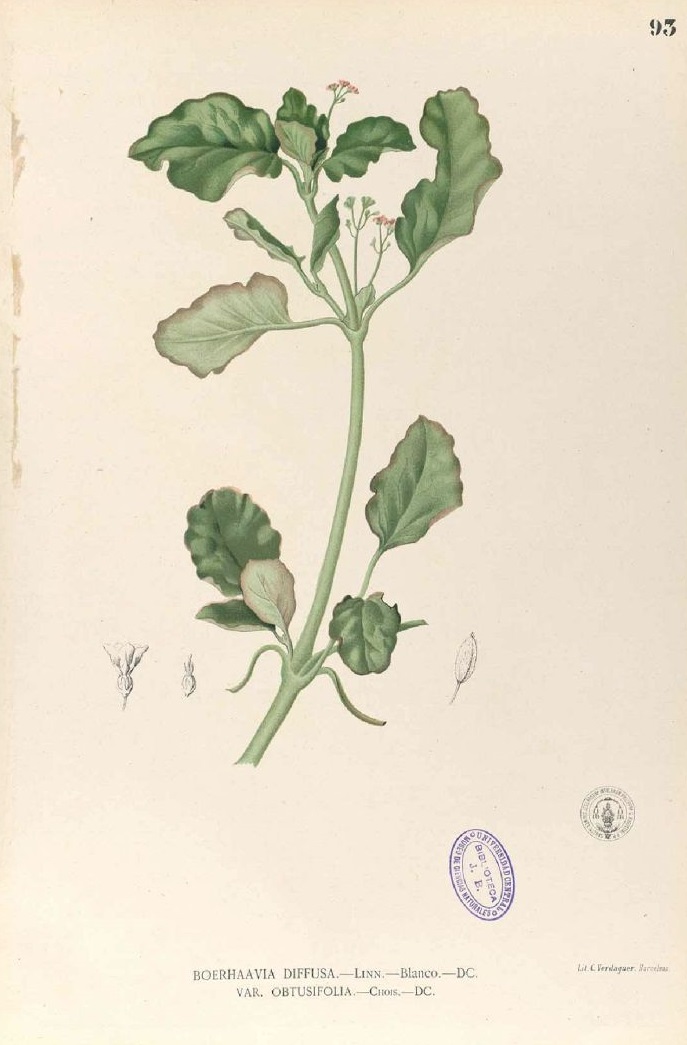
Illustration Boerhavia diffusa, Par Blanco, M., Flora de Filipinas, ed. 3 (1877-1883) Fl. Filip., ed. 3, via plantillustrations
      Illustration Boerhavia diffusa, Par Blanco, M., Flora de Filipinas, ed. 3 (1877-1883) Fl. Filip., ed. 3, via plantillustrations  - Fermer      

Par Blanco, M., Flora de Filipinas, ed. 3 (1877-1883) Fl. Filip., ed. 3, via plantillustrations


  • Dénominations

    :


    • Nom botanique :

      Boerhavia diffusa L. (1753)

    • Synonymes

      :

      Boerhavia paniculata Rich. 1792 ;

    • Noms anglais et locaux

      :

      hogweed, tar vine (tarvine), red spiderling, spreading hogweed, huang xi xin (cn transcrit), red hogweed, ipecacuanha de Cayenne (Guyane), punarnava (in), patagon (local) ;


  • Description et culture

    :


    • dont infos de "FOOD PLANTS INTERNATIONAL" :

      • Description

        :

        Une plante grimpante ou un arbuste à feuilles persistantes qui pond. Il atteint 70 cm de haut. Il s'étend sur environ 50-200 cm de large. La tige est élancée, rampante et volubile. Il a un grand système racinaire. Les feuilles sont vert terne et en paires opposées inégales. Ils mesurent 1 à 2,5 cm de long sur 1 à 2 cm de large. Les feuilles inférieures sont largement ovales tandis que les feuilles supérieures sont plus étroites. Les bords des feuilles sont ondulés. Les fleurs sont jaunes et blanches ou roses. Ils se produisent par groupes de 3 aux extrémités des branches. Ils mesurent 0,5 cm de long. Les fruits mesurent environ 0,4 cm de long. Ils ont des glandes qui les rendent collants. Dans une plante similaire Boerhavia erecta, les fruits sont lisses et non collants.{{{0(+x) (traduction automatique).

        Original : A weedy evergreen vine or shrub which lays over. It grows to 70 cm high. It spreads about 50-200 cm wide. The stem is slender, creeping and twining. It has a large root system. The leaves are dull green and in opposite unequal pairs. They are 1-2.5 cm long by 1-2 cm wide. The lower leaves are broadly oval while the upper leaves are more narrow. The edges of the leaves are wavy. The flowers are yellow and white or pink. They occur in groups of 3 at the ends of branches. They are 0.5 cm long. The fruit are about 0.4 cm long. They have glands that make them sticky. In a similar plant Boerhavia erecta the fruit are smooth and not sticky.,{{{0(+x).

      • Culture

        :

        Les plantes peuvent être cultivées à partir de graines ou de boutures. Les boutures frappent facilement{{{0(+x) (traduction automatique).

        Original : Plants can be grown from seed or cuttings. Cuttings strike easily{{{0(+x).


  • Miam

    Consommation

    (rapports de comestibilité, parties utilisables et usages alimentaires correspondants) :


    Feuilles, racines, fruits, graines, prudence, légumes. Les feuilles tendres sont consommées cuites comme légumeµ{{{0(+x)µ (ex. : potherbeµ{{{(dp*)µ) ; les feuilles récoltées peuvent être stockés pendant 6-7 jours.
    La racine pivotante charnue est cuite et mangée.
    Les graines sont ajoutées aux céréalesµ{{{0(+x)µ. Dans sa Flore phanérogamique des Antilles françaises, p. 481, le R. P. Duss, professeur au Collège de la Basse-Terre, décrit ainsi le Calalou : « On appelle Calalou un mets exquis préparé avec de la petite Valériane à feuilles argentées en dessous, vulgairement nommée Patagon (Boerhaavia paniculata)µ{{{76(+x)µ, et de nombreux autres ingrédients (cf. Xanthosoma helleborifolium, pour la liste complète)µ{{{(dp*)µ.(1*)


    Partie testée

    : racine{{{0(+x) (traduction automatique).

    Original : Root {{{0(+x)

    Taux d'humidité Énergie (kj) Énergie (kcal) Protéines (g)
    50 678 162 4.6

    Pro-
    vitamines A (µg)
    Vitamines C (mg) Fer (mg) Zinc (mg)
    / / 0.3 /


  • Précautions

    Risques et précautions à prendre

    :


    (1*)Attention : il peut causer de la diarrhée s'il est consommé en grandes quantitésµ{{{0(+x)µ


  • Usages médicinaux

    :


    La berce du Caucase est utilisée en médecine traditionnelle dans plusieurs régions de son aire de répartition, mais elle est particulièrement populaire en Inde où elle fait partie de la tradition ayurvédique. On utilise toute la plante, y compris la racine, et on dit qu'elle est amère, diaphorétique, diurétique, émétique, expectorante, laxative et stomacale[46 , 304]. Des recherches ont montré la présence d'un alcaloïde, le bêta-sitostérol et de divers autres composés dans les racines[304]. Un extrait alcoolique de la plante entière a montré une activité anti-inflammatoire significative, un effet cardiotonique, une augmentation de la pression artérielle, un effet relaxant et une activité diurétique prometteuse[304]. La plante est émétique et purgative[348]. Elle est utilisée dans le traitement de diverses affections, notamment les troubles gastriques, l'asthme, la jaunisse, l'anascaris, l'anémie et l'inflammation interne[46 , 304 , 348]. Elle a également été utilisée comme antidote au venin de serpent[304]. Une décoction de feuilles est utilisée pour traiter la jaunisse[46 , 348]. Les feuilles sont utilisées en cataplasme pour traiter le foie induré[348]. La racine peut être utilisée comme substitut de l'ipéca (Carapichea ipecacuanha)[348]. Herbe antispasmodique, très astringente, diurétique, émétique, emménagogue, purgative et sudorifique, elle peut être utilisée en décoction pour traiter la dysenterie et toute une série d'autres affections[348]. Les racines bouillies sont appliquées sur les ulcères, les abcès et pour aider à l'extraction du ver de Guinée[299]µ{{{5(+)µ


  • Autres infos

    :


    dont infos de "FOOD PLANTS INTERNATIONAL" :

    • Statut

      :

      On ne sait pas s'il est utilisé pour l'alimentation en Papouasie-Nouvelle-Guinée. C'est un aliment important à certains endroits{{{0(+x) (traduction automatique).

      Original : It is not known if it is used for food in Papua New Guinea. It is an important food in some places{{{0(+x).

    • Distribution

      :

      C'est une région chaude ou une plante tropicale. Il poussera sur la plupart des sols. Il est résistant à la sécheresse et au gel et très rustique. Il fait mieux dans une position ensoleillée ouverte. Il forme une bonne couverture du sol dans les régions sèches. Il pousse dans tout le Népal jusqu'à environ 2300 m d'altitude. Il pousse dans les zones avec une pluviométrie annuelle supérieure à 300 mm. Il peut pousser dans des endroits arides. Dans XTBG Yunnan{{{0(+x) (traduction automatique).

      Original : It is a warm region or tropical plant. It will grow on most soils. It is drought and frost resistant and very hardy. It does best in an open sunny position. It forms a good ground cover in dry regions. It grows throughout Nepal to about 2300 m altitude. It grows in areas with an annual rainfall above 300 mm. It can grow in arid places. In XTBG Yunnan{{{0(+x).

    • Localisation

      :

      Afghanistan, Afrique, Angola, Argentine, Asie, Australie (Non), Bangladesh, Bénin, Bhoutan, Bolivie, Botswana, Brésil, Burkina Faso, Cambodge, Chili, Chine, RD Congo, Côte d'Ivoire, République dominicaine, Est Afrique, Île de Pâques, Eswatini, Fidji, Gambie, Guam, Guyane, Guyanes, Guinée, Guinée, Guinée-Bissau, Guyane, Haïti, Himalaya, Inde, Indochine, Indonésie, Iran, Côte d'Ivoire, Japon (Ryuku), Laos , Liberia, Madagascar, Malawi, Malaisie, Maldives, Mali, Îles Marshall, Mauritanie, Micronésie, Mozambique, Myanmar, Namibie, Népal, Nigéria, Nord-est de l'Inde, Pacifique, Pakistan, Papouasie-Nouvelle-Guinée, PNG, Paraguay, Pérou, Philippines, Rwanda , Sao Tomé-et-Principe, Asie du Sud-Est, Sénégal, Sierra Leone, Afrique du Sud, Afrique australe, Amérique du Sud, Sri Lanka, Suriname, Swaziland, Taiwan, Thaïlande, Tonga, Uruguay, Vietnam, Afrique de l'Ouest, Antilles, Yémen,Zambie, Zimbabwe{{{0(+x) (traduction automatique).

      Original : Afghanistan, Africa, Angola, Argentina, Asia, Australia (Not), Bangladesh, Benin, Bhutan, Bolivia, Botswana, Brazil, Burkina Faso, Cambodia, Chile, China, Congo DR, Côte d'Ivoire, Dominican Republic, East Africa, Easter Island, Eswatini, Fiji, Gambia, Guam, Guiana, Guianas, Guinea, Guinée, Guinea-Bissau, Guyana, Haiti, Himalayas, India, Indochina, Indonesia, Iran, Ivory Coast, Japan (Ryuku), Laos, Liberia, Madagascar, Malawi, Malaysia, Maldives, Mali, Marshall Islands, Mauritania, Micronesia, Mozambique, Myanmar, Namibia, Nepal, Nigeria, Northeastern India, Pacific, Pakistan, Papua New Guinea, PNG, Paraguay, Peru, Philippines, Rwanda, Sao Tome and Principe, SE Asia, Senegal, Sierra Leone, South Africa, Southern Africa, South America, Sri Lanka, Suriname, Swaziland, Taiwan, Thailand, Tonga, Uruguay, Vietnam, West Africa, West Indies, Yemen, Zambia, Zimbabwe{{{0(+x).

    • Notes

      :

      Cette plante a des propriétés médicinales pour les affections rénales et urinaires. Il existe environ 40 espèces de Boerhavia. Ils se trouvent principalement dans les régions tropicales et subtropicales. Composition chimique (racine): Sable (échantillon sec) = 0,34%; (échantillon frais) = 0,17%. Silice (échantillon sec) = 0,22%; (échantillon frais) = 0,11%. Calcium (échantillon sec) = 1,246%, (échantillon frais) = 0,623%. Magnésium (échantillon sec) = 0,344%, (échantillon frais) = 0,172%. Phosphore (échantillon sec = 0,155 ^%, (échantillon frais) = 0,077%. Potassium (échantillon sec) = 2,89%, (échantillon frais) = 1,440%. Ca: 8,03. Fe: 345. Cu: 6. Mn: 20 ( en ppm sur la base de P sec). Humidité = 50. Fibres (échantillon brut, sec) = 9,6%, (échantillon frais) = 4,8%. Extrait d'éther (échantillon sec) = 1,62%, (échantillon frais) = 0,91%. Protéine (échantillon brut, sec) = 9,1%, (échantillon frais) = 4,56%. Cendres (échantillon sec) = 8,42%, (échantillon frais) = 4,21%. Glucides (échantillon sec) = 71,2%, (échantillon frais) = 35,6%. Azote albumineux (échantillon sec) = 1,02%, (échantillon frais) = 0,51%. Azote amido (échantillon sec) = 0,44%; échantillon frais) = 0,22%. Valeur de carburant [calories] (échantillon sec) = 29,0, (échantillon frais) = 58,0{{{0(+x) (traduction automatique).

      Original : This plant has medicinal properties for kidney and urine conditions. There are about 40 Boerhavia species. They are mostly in the tropics and subtropics. Chemical composition (root): Sand (dry sample) = 0.34%; (fresh sample) = 0.17%. Silica (dry sample) = 0.22%; (fresh sample) = 0.11%. Calcium (dry sample) = 1.246%, (fresh sample) = 0.623%. Magnesium (dry sample) = 0.344%, (fresh sample) = 0.172%. Phosphorus (dry sample = 0.155^%, (fresh sample) = 0.077%. Potassium (dry sample) = 2.89%, (fresh sample) = 1.440%. Ca: 8.03. Fe: 345. Cu: 6. Mn: 20 (in ppm on dry P basis). Moisture = 50. Fibre (crude, dry sample) = 9.6%, (fresh sample) = 4.8%. Ether extract (dry sample) = 1.62%, (fresh sample) = 0.91%. Protein (crude, dry sample) = 9.1%, (fresh sample) = 4.56%. Ash (dry sample) = 8.42%, (fresh sample) = 4.21%. Carbohydrate (dry sample) = 71.2%, (fresh sample) = 35.6%. Albuminous nitrogen (dry sample) = 1.02%, (fresh sample) = 0.51%. Amido nitrogen (dry sample) = 0.44%; fresh sample) = 0.22%. Fuel value [calories] (dry sample) = 29.0, (fresh sample) = 58.0{{{0(+x).


  • Liens, sources et/ou références


    • Sources et/ou références :

      5"Plants For A Future" (en anglais) ;

      dont classification :
      "The Plant List" (en anglais) ; "GRIN" (en anglais) ; Kew (POWO - "Plant Of the World Online", "Royal Botanical Garden", en anglais) ;

      dont livres et bases de données : 0"Food Plants International" (en anglais), 76Le Potager d'un curieux - histoire, culture et usages de 250 plantes comestibles peu connues ou inconnues (livre, page 206 [Boerhavia paniculata], par A. Paillieux et D. Bois) ;

      76Le potager d'un curieux - histoire, culture et usages de 250 plantes comestibles, peu connues ou inconnue (par Auguste Pailleux et Désiré Bois, 3ème édition de 1899) / détails du livre

      dont biographie/références de "FOOD PLANTS INTERNATIONAL" :

      Achigan-Dako, E, et al (Eds), 2009, Catalogue of Traditional Vegetables in Benin. International Foundation for Science. Ambasta, S.P. (Ed.), 2000, The Useful Plants of India. CSIR India. p 76 Bircher, A. G. & Bircher, W. H., 2000, Encyclopedia of Fruit Trees and Edible Flowering Plants in Egypt and the Subtropics. AUC Press. p 60 Bodkin, F., 1991, Encyclopedia Botanica. Cornstalk publishing, p 152 Burkill, H. M., 1985, The useful plants of west tropical Africa, Vol. 4. Kew. Burkill, I.H., 1966, A Dictionary of the Economic Products of the Malay Peninsula. Ministry of Agriculture and Cooperatives, Kuala Lumpur, Malaysia. Vol 1 (A-H) p 346 Cherikoff V. & Isaacs, J., The Bush Food Handbook. How to gather, grow, process and cook Australian Wild Foods. Ti Tree Press, Australia p 188, 194 Cribb, A.B. & J.W., 1976, Wild Food in Australia, Fontana. p 146 DADSWELL, Dalziel, J. M., 1937, The Useful plants of west tropical Africa. Crown Agents for the Colonies London. Dutta, U., 2012, Wild Vegetables collected by the local communities from the Churang reserve if BTDm Assam. International Journal of Science and Advanced Technology. Vol. 2(4) p 119 Elliot, W.R., & Jones, D.L., 1982, Encyclopedia of Australian Plants suitable for cultivation. Vol 2. Lothian. p 332 Flora of Australia, Volume 4, Phytolaccaceae to Chenopodiaceae, Australian Government Publishing Service, Canberra (1984) p 13 NB species does not occur in Australia Food Composition Tables for use in Africa FAO https://www.fao.org/infoods/directory No. 943 Fowler, D. G., 2007, Zambian Plants: Their Vernacular Names and Uses. Kew. p 50 Grivetti, L. E., 1980, Agricultural development: present and potential role of edible wild plants. Part 2: Sub-Saharan Africa, Report to the Department of State Agency for International Development. p 30 GUPTA & KANODIA, Hall, N. et al, 1972, The Use of Trees and Shrubs in the Dry Country of Australia, AGPS, Canberra. p 178 Henty, E.E., & Pritchard, G.S., 1973, Weeds of New Guinea and their control. Botany Bulletin No 7, Division of Botany, Lae, PNG. p 128 Hu, Shiu-ying, 2005, Food Plants of China. The Chinese University Press. p 383 IRVINE; Jardin, C., 1970, List of Foods Used In Africa, FAO Nutrition Information Document Series No 2.p 59, 123 Kouahkou-Siransy, G., et al, 2010, Oxygen species scavenger activities and phenolic contents of four West African plants. Food Chemistry 118: 430-435 Latz, P.K., 1996, Bushfires and Bushtucker: Aboriginal plant use in Central Australia. IAD Press Alice Springs p 130 Levitt, D., 1981, Plants and people. Aboriginal uses of plants on Groote Eylandt. Australian Institute of Aboriginal Studies, Canberra. p 111 Long, C., 2005, Swaziland's Flora - siSwati names and Uses https://www.sntc.org.sz/flora/ Low, T., 1991, Wild Food Plants of Australia. Australian Nature FieldGuide, Angus & Robertson. p 160 Lu De-quan, Nyctaginaceae. Flora of China Macmillan, H.F. (Revised Barlow, H.S., et al), 1991, Tropical Planting and Gardening. Sixth edition. Malayan Nature Society. Kuala Lumpur. p 356 Manandhar, N.P., 2002, Plants and People of Nepal. Timber Press. Portland, Oregon. p 116 Martin, F.W. & Ruberte, R.M., 1979, Edible Leaves of the Tropics. Antillian College Press, Mayaguez, Puerto Rico. p 208 McMakin, P.D., 2000, Flowering Plants of Thailand. A Field Guide. White Lotus. p 99 Mertz, O., Lykke, A. M., and Reenberg, A., 2001, Importance and Seasonality of Vegetable Consumption and Marketing in Burkina Faso. Economic Botany, 55(2):276-289 Morley, B.D., & Toelken, H.R., (Eds), 1983, Flowering Plants in Australia. Rigby. p 71 Muzila, M., 2006. Boerhavia diffusa L. [Internet] Record from Protabase. Schmelzer, G.H. & Gurib-Fakim, A. (Editors). PROTA (Plant Resources of Tropical Africa), Wageningen, Netherlands. {{{ https://database.prota.org/search.htm>. Accessed 14 October 2009. Okigbo, B.N., Vegetables in Tropical Africa, in Opena, R.T. & Kyomo, M.L., 1990, Vegetable Research and development in SADCC countries. Asian Vegetable Research and development Centre. Taiwan. p 44 Patiri, B. & Borah, A., 2007, Wild Edible Plants of Assam. Geethaki Publishers. p 106 Peekel, P.G., 1984, (Translation E.E.Henty), Flora of the Bismarck Archipelago for Naturalists, Division of Botany, Lae, PNG. p 172, 171 Peters, C. R., O'Brien, E. M., and Drummond, R.B., 1992, Edible Wild plants of Sub-saharan Africa. Kew. p 155 Pham-Hoang Ho, 1999, An Illustrated Flora of Vietnam. Nha Xuat Ban Tre. p 717 Plants For A Future database, The Field, Penpol, Lostwithiel, Cornwall, PL22 0NG, UK. https://www.scs.leeds.ac.uk/pfaf/ Plants of Haiti Smithsonian Institute https://botany.si.edu/antilles/West Indies Plowes, N. J. & Taylor, F. W., 1997, The Processing of Indigenous Fruits and other Wildfoods of Southern Africa. in Smartt, L. & Haq. (Eds) Domestication, Production and Utilization of New Crops. ICUC p 186 Rajkalkshmi, P. et al, 2001, Total carotenoid and beta-carotene contents of forest green leafy vegetables consumed by tribals of south India. Plant Foods for Human Nutrition 56:225-238 Royal Botanic Gardens, Kew (1999). Survey of Economic Plants for Arid and Semi-Arid Lands (SEPASAL) database. Published on the Internet; https://www.rbgkew.org.uk/ceb/sepasal/internet [Accessed 4th May 2011] Sarma, H., et al, 2010, Updated Estimates of Wild Edible and Threatened Plants of Assam: A Meta-analysis. International Journal of Botany 6(4): 414-423 SHANKARNARAYAN & SAXENA, Singh, H.B., Arora R.K.,1978, Wild edible Plants of India. Indian Council of Agricultural Research, New Delhi. p18 Smith, A.C., 1981, Flora Vitiensis Nova, Lawaii, Kuai, Hawaii, Volume 2 p 264 Specht, R.L., 1958, Sp. pl. 1:3. 1753 Swaziland's Flora Database https://www.sntc.org.sz/flora Terra, G.J.A., 1973, Tropical Vegetables. Communication 54e Royal Tropical Institute, Amsterdam, p 29 Vernon, R., 1983, Field Guide to Important Arable Weeds of Zambia. Dept of Agriculture, Chilanga, Zambia. p 30 WATT Wrigley, J.W., & Fagg, M., 1982, Australian Native Plants. Collns. p 7 Yuncker, T.G., 1959, Plants of Tonga, Bernice P. Bishop Museum, Hawaii, Bulletin 220. p 109 Zon, A.P.M. van der, Grubben, G.J.H., 1976, Les legumes-feuilles spontanes et cultives du Sud-Dahomey, Communication 65, Royal Tropical Institute, Amsterdam, p 38

    • Recherche de/pour :


Dernière modification le :
vendredi 04 septembre 2026, à 09h25


Wikipedia
Flèche gauche||Flèche droite

Wikimedia
Flèche gauche||Flèche droite

Wikispecies
Flèche gauche||Flèche droite


Semeurs.fr
Flèche gauche||Flèche droite


Enregistrer et/ou imprimer cette fiche : Aperçu (format pdf) Enregistrer cette fiche : format pdf

Recherche simple :


Recherche multicritères :


Partie comestible :
Fruit Feuille Fleur
Racine Tronc
Note comestibilité :
* ** *** **** ***** |
Note médicinale :
* ** *** **** *****


Page de recherche


Responsabilité : Le Potager de mes Rêves (ainsi que tout membre de cette association) ne peut être tenu responsable pour toute allergie, maladie ou effet nuisible que toute personne ou animal pourrait subir suite à l'utilisation de toute plante mentionnée sur ce site :
(https://lepotager-demesreves.fr) ;
Cf. "Notes et mises en garde", pour plus d'informations sur les précautions à prendre.


Licence Creative Commons


Partager sur Facebook


Valid XHTML 1.0 Strict CSS Valide !