le A, qui pointe vers le haut, permet de remonter,
le V, qui pointe vers le bas, permet de descendre,
le I permet de dérouler toute la page (les différentes catégories)
et le O amène ici, où vous pouvez revenir à l'origine,
en cliquant n'importe où 🙂
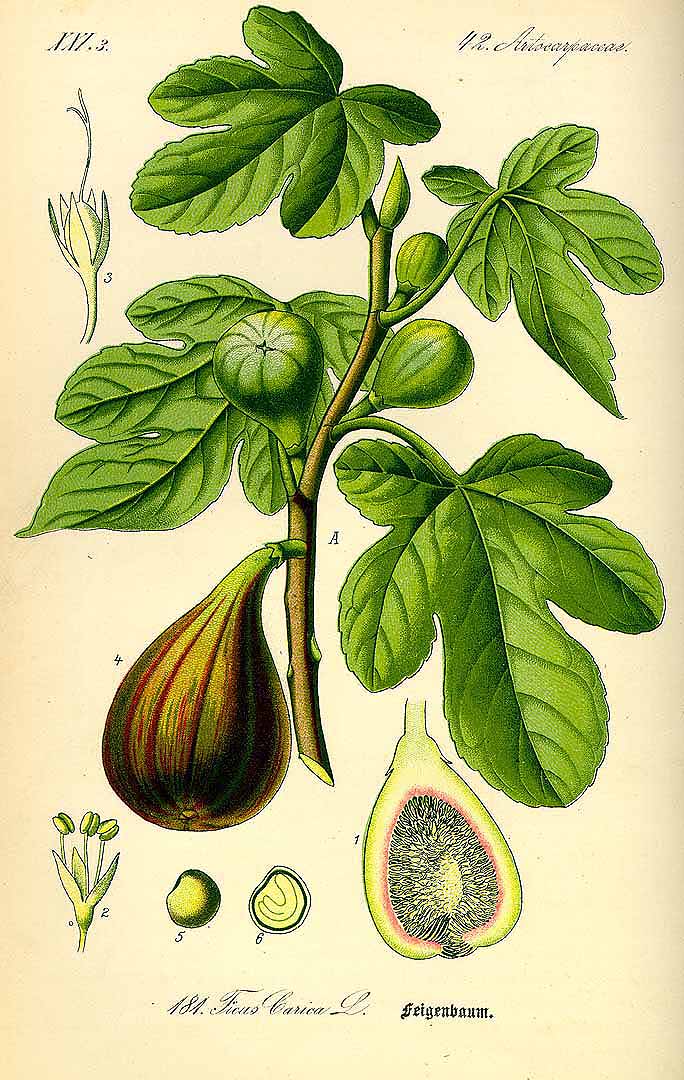
Une figue. C'est un arbre à feuilles caduques peu étalé avec de grandes feuilles. Il peut atteindre 10 m de haut. Les arbres sont largement répandus avec de nombreuses branches. Il a de la sève laiteuse. Les petites branches sont droites et fortes. Les feuilles s'étalent comme des doigts sur une main à 3 ou 5 lobes. Les feuilles sont de texture rugueuse sur la face supérieure et duveteuses en dessous. Les fleurs sont d'un seul sexe. Il existe deux formes sexuelles - le caprifig et la figue. Les caprifigs sont secs et durs et se développent 3 fois par an. Ils abritent la guêpe figue qui elle-même passe par 3 étapes différentes de son cycle de vie au cours de ces 3 saisons fruitières. Le "fruit" est un récipient creux avec une ouverture à l'extrémité. À l'intérieur, les fleurs poussent et mûrissent. Le vrai fruit se développe à l'intérieur de ce grand réceptacle. Ils sont produits seuls ou par paires à l'aisselle des feuilles. La couleur des fruits peut varier du noir au brun, au vert et au jaune. Les figues sauvages ont à la fois des parties de fleurs mâles et femelles, mais les figues cultivées n'ont pas de parties de fleurs mâles et les fruits se développent sans fertilisation pour les figues de l'Adriatique, mais ont besoin d'une guêpe figue pour les figues de Smyrne. Il existe plusieurs centaines d'espèces de figues cultivées{{{0(+x) (traduction automatique).
Original : A fig. It is a low spreading deciduous tree with large leaves. It can grow to 10 m high. Trees are widely spreading with many branches. It has milky sap. The small branches are straight and strong. The leaves spread out like fingers on a hand with 3 or 5 lobes. The leaves are rough textured on the upper surface and downy underneath. The flowers are of one sex only. There are two sex forms - the caprifig and the fig. The caprifigs are dry and hard and develop 3 times a year. They harbour the fig wasp which itself goes through 3 different stages of its life cycle in these 3 fruit seasons. The "fruit" is a hollow receptacle with an opening at the tip. Inside this the flowers grow and mature. The true fruit develop inside this large receptacle. They are produced either singly or in pairs in the axils of leaves. Fruit colour can vary from black, brown, green and yellow. Wild figs have both male and female flower parts but cultivated figs have no male flower parts and the fruit develop without fertilisation for Adriatic figs but need a fig wasp for Smyrna figs. There are several hundred cultivated kinds of fig{{{0(+x).
Production
:
Les figues commencent à porter après environ 5 à 7 ans et peuvent continuer pendant des décennies, mais elles deviennent non rentables après 50 ans. Les fruits mûrissent dans leur deuxième année. Normalement, les figues ont 2 récoltes par an. La première récolte provient de vieux bois et la seconde de bois plus récent{{{0(+x) (traduction automatique).
Original : Figs start to bear after about 5-7 years and can continue for decades but they become unprofitable after 50 years. Fruit ripen in their second year. Normally figs have 2 harvests per year. The first crop is from old wood and the second from newer wood{{{0(+x).
Culture
:
Les plantes peuvent être cultivées par graines. Il peut être cultivé par boutures de tige. Il peut également être cultivé par bourgeonnement et greffage. Les figues de Smyrne ont besoin de guêpes figues pour la pollinisation. Cela se fait en accrochant des fleurs mâles près des fleurs femelles pour attirer les guêpes. Les figues de l'Adriatique développent des fruits sans pollinisation. Les arbres doivent être taillés pour une bonne production et une récolte facile{{{0(+x) (traduction automatique).
Original : Plants can be grown by seeds. It can be grown by stem cuttings. It can also be grown by budding and grafting. Smyrna figs need fig wasps for pollination. This is done by hanging male flowers near female flowers to attract the wasps. Adriatic figs develop fruit without pollination. Trees should be pruned for good production and easy harvesting{{{0(+x).
Consommation
(rapports de comestibilité, parties utilisables et usages alimentaires correspondants) :
Les fruits crus ou cuits sont doux et succulents ; un spécimen bien mûr est un fruit exquis qui fond presque littéralement dans la bouche ; le fruit est souvent séché pour une utilisation ultérieure, et ce fruit séché est un élément majeur du commerce ; les figues sont généralement en forme de poire et jusqu'à 5cm de diamètreµ{{{5(+)µ ; elles peuvent également être mises en conserves ou utilisées dans lesµ{{{~~0(+x)µ confituresµ0(+x),27(+x)µ, sirops, pain, pâtisseries et tartes ou encore transformées en brandy (eau de vie) et vin.
De la nourriture est enveloppée dans des feuilles pendant la cuisson pour leur donner leur arôme.
Le latex de la sèveµ{{{~~0(5(+),+x)µ (suc des feuillesµ{{{(dp*)µ) peut être utilisé pour coaguler le lait (coagulation des laits végétaux pour le fromage et le lait caillé)µ{{{~~0(5(+),+x)µ. Avant la guerre 14/18, on faisait cailler le lait en incorporant à celui-ci (préchauffé à 40°C) une ou deux jeunes feuilles de figuier : le résultat est parfait surtout avec du lait cru (non stérélisé){{{Forum "aufeminin.com" . Plante largement cultivée dans le monde dans les régions tempéréesµ{{{27(+x)µ.
Partie testée
: fruit vert cru{{{0(+x) (traduction automatique).
Ils ont été introduits en Papouasie-Nouvelle-Guinée et essayés mais ne sont pas courants{{{0(+x) (traduction automatique).
Original : They have been introduced to Papua New Guinea, and tried but are not common{{{0(+x).
Distribution
:
Il convient aux régions tropicales, subtropicales et tempérées chaudes. Il est originaire d'Asie du Sud-Ouest. Il peut supporter de légères gelées une fois durci. Parmi le très grand nombre de figues en PNG, celle-ci est introduite. Il convient aux régions montagneuses des tropiques avec des précipitations plus faibles. Il produit mieux si la pluie est moindre à la floraison. Une bonne chaleur estivale est nécessaire pour les fruits riches en sucre. Les plantes réussissent mieux dans un sol lourd dans des sites bien préparés. Il a besoin d'un pH neutre. Il a une certaine tolérance au sel. Dans les jardins botaniques de Brisbane. Au Népal, il atteint environ 1200 m d'altitude. Dans certains endroits, il peut atteindre 2300 m au-dessus du niveau de la mer. Il convient aux zones de rusticité 10-12. Au Sichuan. Au Yunnan{{{0(+x) (traduction automatique).
Original : It suits tropical, subtropical and warm temperate regions. It is native to S.W. Asia. It can stand light frosts once hardened. Of the very large number of figs in PNG, this one is introduced. It suits highland areas in the tropics with a lower rainfall. It produces better if rain is less at flowering. Good summer heat is necessary for sugar-rich fruit. Plants do best in heavy soil in well prepared sites. It needs a neutral pH. It has some salt tolerance. In Brisbane Botanical Gardens. In Nepal it grows to about 1200 m altitude. In some places it can grow up to 2,300 m above sea level. It suits hardiness zones 10-12. In Sichuan. In Yunnan{{{0(+x).
Localisation
:
Afghanistan, Africa, Albania, Algeria, Armenia, Australia, Azerbaijan, Bahrain, Bangladesh, Brazil, Britain, Bulgaria, Burkina Faso, Canada, Caucasus, Central America, Central Asia, China, Cook Islands, Costa Rica, Crete, Cuba, Cyprus, Dominican Republic, East Africa, Easter Island, Ecuador, Egypt, Ethiopia, Europe, Fiji, France, Georgia, Germany, Gibraltar, Greece, Guam, Haiti, Hawaii, Himalayas, India, Indochina, Indonesia, Iran, Iraq, Israel, Italy, Jamaica, Jordan, Kiribati, Korea, Lebanon, Macedonia, Madagascar, Malawi, Malta, Mauritania, Mediterranean, Mexico, Micronesia, Montenegro, Morocco, Myanmar, Nepal, New Zealand, Niger, North Africa, North America, Northeastern India, Pacific, Pakistan, Palau, Palestine, Papua New Guinea, PNG, Philippines, Portugal, Puerto Rico, Qatar, Russia, Sao Tome and Principe, Saudi Arabia, SE Asia, Serbia, Sinai, Slovenia, South Africa, Southern Africa, South America, Spain, Syria, Tajikistan, Tasmania, Thailand, Tonga, Tunisia, Turkey, Turkmenistan, Tuvalu, United Arab Emirates, UAE, Uruguay, USA, Uzbekistan, West Africa, West Indies, Zimbabwe{{{0(+x) (traduction automatique).
Original : Afghanistan, Africa, Albania, Algeria, Armenia, Australia, Azerbaijan, Bahrain, Bangladesh, Brazil, Britain, Bulgaria, Burkina Faso, Canada, Caucasus, Central America, Central Asia, China, Cook Islands, Costa Rica, Crete, Cuba, Cyprus, Dominican Republic, East Africa, Easter Island, Ecuador, Egypt, Ethiopia, Europe, Fiji, France, Georgia, Germany, Gibraltar, Greece, Guam, Haiti, Hawaii, Himalayas, India, Indochina, Indonesia, Iran, Iraq, Israel, Italy, Jamaica, Jordan, Kiribati, Korea, Lebanon, Macedonia, Madagascar, Malawi, Malta, Mauritania, Mediterranean, Mexico, Micronesia, Montenegro, Morocco, Myanmar, Nepal, New Zealand, Niger, North Africa, North America, Northeastern India, Pacific, Pakistan, Palau, Palestine, Papua New Guinea, PNG, Philippines, Portugal, Puerto Rico, Qatar, Russia, Sao Tome and Principe, Saudi Arabia, SE Asia, Serbia, Sinai, Slovenia, South Africa, Southern Africa, South America, Spain, Syria, Tajikistan, Tasmania, Thailand, Tonga, Tunisia, Turkey, Turkmenistan, Tuvalu, United Arab Emirates, UAE, Uruguay, USA, Uzbekistan, West Africa, West Indies, Zimbabwe{{{0(+x).
Notes
:
Il existe environ 800-1000 espèces de Ficus. Ils sont principalement sous les tropiques. Il existe 120 espèces de Ficus en Amérique tropicale. Il a des propriétés anticancéreuses{{{0(+x) (traduction automatique).
Original : There are about 800-1000 Ficus species. They are mostly in the tropics. There are 120 Ficus species in tropical America. It has anticancer properties{{{0(+x).
dont livres et bases de données : 0"Food Plants International" (en anglais), 27Dictionnaire des plantes comestibles (livre, page 136, par Louis Bubenicek) ;
dont biographie/références de "FOOD PLANTS INTERNATIONAL" : Ambasta, S.P. (Ed.), 2000, The Useful Plants of India. CSIR India. p 221
Anderson, E. F., 1993, Plants and people of the Golden Triangle. Dioscorides Press. p 211
Blamey, M and Grey-Wilson, C., 2005, Wild flowers of the Mediterranean. A & C Black London. p 34
Bekele-Tesemma A., Birnie, A., & Tengnas, B., 1993, Useful Trees and Shrubs for Ethiopia. Regional Soil Conservation Unit. Technical Handbook No 5. p 244
Bernholt, H. et al, 2009, Plant species richness and diversity in urban and peri-urban gardens of Niamey, Niger. Agroforestry Systems 77:159-179
Bodkin, F., 1991, Encyclopedia Botanica. Cornstalk publishing, p 472
Bremness, L., 1994, Herbs. Collins Eyewitness Handbooks. Harper Collins. p 57
Brickell, C. (Ed.), 1999, The Royal Horticultural Society A-Z Encyclopedia of Garden Plants. Convent Garden Books. p 438
Brouk, B., 1975, Plants Consumed by Man. Academic Press, London. p 173
Brown, D., 2002, The Royal Horticultural Society encyclopedia of Herbs and their uses. DK Books. p 213
Burkill, H. M., 1985, The useful plants of west tropical Africa, Vol. 4. Kew.
Burkill, I.H., 1966, A Dictionary of the Economic Products of the Malay Peninsula. Ministry of Agriculture and Cooperatives, Kuala Lumpur, Malaysia. Vol 1 (A-H) p 1022
Cheifetz, A., (ed), 1999, 500 popular vegetables, herbs, fruits and nuts for Australian Gardeners. Random House p 193
Coombes, A.J., 2000, Trees. Dorling Kindersley Handbooks. p 219
Coronel, R.E., 1982, Fruit Collections in the Philippines. IBPGR Newsletter p 10
Cull, B.W., 1995, Fruit Growing in Warm Climates. Reed. p 159
Cundall, P., (ed.), 2004, Gardening Australia: flora: the gardener's bible. ABC Books. p 602
Della, A., et al, 2006, An ethnobotanical survey of wild edible plants of Paphos and Larnaca countryside of Cyprus. J. Ethnobiol. Ethnomed. 2:34
Ertug, F., 2004, Wild Edible Plants of the Bodrum Area. (Mugla, Turkey). Turk. J. Bot. 28 (2004): 161-174
Etherington, K., & Imwold, D., (Eds), 2001, Botanica's Trees & Shrubs. The illustrated A-Z of over 8500 trees and shrubs. Random House, Australia. p 326
Facciola, S., 1998, Cornucopia 2: a Source Book of Edible Plants. Kampong Publications, p 155
Flora of China.
Flora of Pakistan. www.eFloras.org
Flowerdew, B., 2000, Complete Fruit Book. Kyle Cathie Ltd., London. p 54
French, B.R., 1986, Food Plants of Papua New Guinea, A Compendium. Asia Pacific Science Foundation p 287
Harris, E & J., 1983, Field Guide to the Trees and Shrubs of Britain. Reader's Digest. p 140
Hedrick, U.P., 1919, (Ed.), Sturtevant's edible plants of the world. p 308
Heywood, V.H., Brummitt, R.K., Culham, A., and Seberg, O. 2007, Flowering Plant Families of the World. Royal Botanical Gardens, Kew. p 218
Hussey, B.M.J., Keighery, G.J., Cousens, R.D., Dodd, J., Lloyd, S.G., 1997, Western Weeds. A guide to the weeds of Western Australia. Plant Protection Society of Western Australia. p 182
Hu, Shiu-ying, 2005, Food Plants of China. The Chinese University Press. p 358
Jardin, C., 1970, List of Foods Used In Africa, FAO Nutrition Information Document Series No 2.p 136
John, L., & Stevenson, V., 1979, The Complete Book of Fruit. Angus & Robertson p 132
Kintzios, S. E., 2006, Terrestrial Plant-Derived Anticancer Agents and Plant Species Used in Anticancer research. Critical Reviews in Plant Sciences. 25: pp 79-113
Kiple, K.F. & Ornelas, K.C., (eds), 2000, The Cambridge World History of Food. CUP p 1774
Lazarides, M. & Hince, B., 1993, Handbook of Economic Plants of Australia, CSIRO. p 114
Llamas, K.A., 2003, Tropical Flowering Plants. Timber Press. p 278
Lorenzi, H., Bacher, L., Lacerda, M. & Sartori, S., 2006, Brazilian Fruits & Cultivated Exotics. Sao Paulo, Instituto Plantarum de Estuados da Flora Ltda. p 439
Lyle, S., 2006, Discovering fruit and nuts. Land Links. p 204
Macmillan, H.F. (Revised Barlow, H.S., et al) 1991, Tropical Planting and Gardening. Sixth edition. Malayan Nature Society. Kuala Lumpur. p 315
Martin, F. W., et al, 1987, Perennial Edible Fruits of the Tropics. USDA Handbook 642 p 37
Morley, B.D., & Toelken, H.R., (Eds), 1983, Flowering Plants in Australia. Rigby. p 63
Morton, J. F., 1987, Fruits of Warm Climates. Wipf & Stock Publishers p 47
Norrington, L., & Campbell, C., 2001, Tropical Food Gardens. Bloomings Books. p 101
Paczkowska, G . & Chapman, A.R., 2000, The Western Australian Flora. A Descriptive Calatogue. Western Australian Herbarium. p 331
Pieroni, A., 1999, Gathered wild food plants in the Upper Valley of the Serchio River (Garfagnana), Central Italy. Economic Botany 53(3) pp 327-341
Plants For A Future database, The Field, Penpol, Lostwithiel, Cornwall, PL22 0NG, UK.
https://www.scs.leeds.ac.uk/pfaf/
Plants of Haiti Smithsonian Institute https://botany.si.edu/antilles/West Indies
Purseglove, J.W., 1968, Tropical Crops Dicotyledons, Longmans. p 388
Sharma, B.B., 2005, Growing fruits and vegetables. Publications Division. Ministry of Information and broadcasting. India. p 60
Sher, H. et al, 2011, Ethnobotanical and Economic Observations of Some Plant Resources from the Northern Parts of Pakistan. Ethnobotany research & Applications 9:027-041
Sinclair, V., 1992, The Floral Charm of Cyprus. Interworld Publications. p 156
Smith, A.C., 1981, Flora Vitiensis Nova, Lawaii, Kuai, Hawaii, Volume 2 p 179
Smith, K., 1998. Growing Uncommon Fruits and Vegetables. New Holland. p 136
Sp. pl. 2:1059. 1753
Staples, G.W. and Herbst, D.R., 2005, A tropical Garden Flora. Bishop Museum Press, Honolulu, Hawaii. p 409
Storey, W.B., 1979, Fig, in Simmonds, N.W., (ed), Crop Plant Evolution. Longmans. London. p 205
Swaminathan, M.S., and Kochnar, S.L., 2007, An Atlas of major Flowering Trees in India. Macmillan. p 260
Thaman, R.R., 1976, The Tongan Agricultural System, University of the South Pacific, Suva, Fiji. p 399
USDA, ARS, National Genetic Resources Program. Germplasm Resources Information Network - (GRIN). [Online Database] National Germplasm Resources Laboratory, Beltsville, Maryland. Available: www.ars-grin.gov/cgi-bin/npgs/html/econ.pl (10 April 2000)
Valder, P., 1999, The Garden Plants of China. Florilegium. p 285
van Wyk, Be., & Gericke, N., 2007, People's plants. A Guide to Useful Plants of Southern Africa. Briza. p 42
Wild Edible Plants in Lebanon. Promoting dietary diversity in poor communities in Lebanon. https://www.wildedibleplants.org/
Young, J., (Ed.), 2001, Botanica's Pocket Trees and Shrubs. Random House. p 384
Responsabilité : Le Potager de mes Rêves (ainsi que tout membre de cette association) ne peut être tenu responsable pour toute allergie,
maladie ou effet nuisible que toute personne ou animal pourrait subir suite à l'utilisation de toute plante mentionnée sur ce site
: (https://lepotager-demesreves.fr) ;
Cf. "Notes et mises en garde", pour plus
d'informations sur les précautions à prendre.
Sauf mention contraire, ce travail est publié sous licence Creative Commons :