le A, qui pointe vers le haut, permet de remonter,
le V, qui pointe vers le bas, permet de descendre,
le I permet de dérouler toute la page (les différentes catégories)
et le O amène ici, où vous pouvez revenir à l'origine,
en cliquant n'importe où 🙂
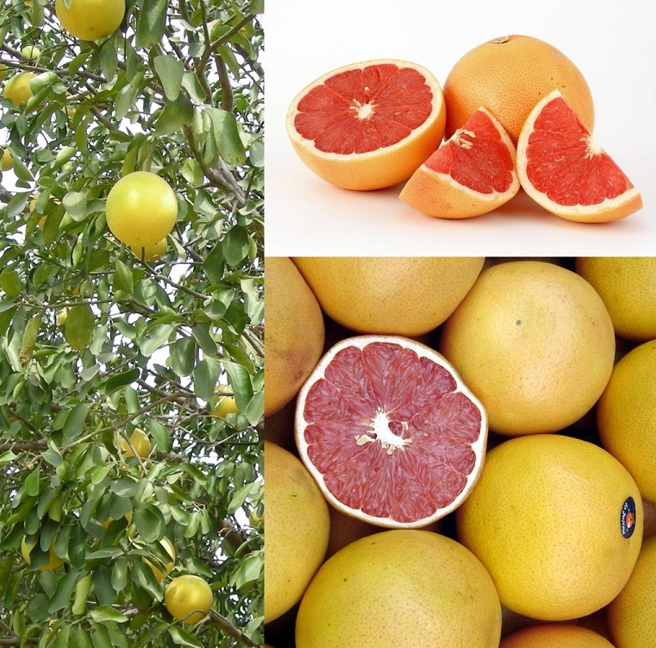
Probablement un hybride naturel entre l'orange douce et le pomelo. Un arbre à feuilles persistantes de taille moyenne atteignant 10-15 m de haut. Ils s'étalent sur 5 m de diamètre. La tige est robuste et tordue. Les branches pendent et donnent une couronne arrondie. Les épines sont petites. Les feuilles sont d'un vert foncé brillant et en forme d'épée. Ils peuvent mesurer 18 cm de long. Les feuilles sont coriaces et ont des dents arrondies le long du bord. La tige de la feuille a généralement une large aile. Les fleurs sont d'un blanc crème et grandes. Les fleurs se produisent seules ou en grappes (2-20) à l'aisselle des feuilles. Les fleurs mesurent 4 à 5 cm de diamètre. Les fruits sont gros, jaunes et en grappes. Les fruits peuvent mesurer de 9 à 15 cm de diamètre. Les fruits sont très juteux avec une pulpe aigre-douce. Les sacs de jus sont grands mais serrés. Il existe de nombreuses variétés cultivées{{{0(+x) (traduction automatique).
Original : Probably a natural hybrid between sweet orange and pomelo. A medium sized evergreen tree up to 10-15 m high. They spread 5 m across. The stem is stout and crooked. The branches hang down giving a rounded crown. The thorns are small. The leaves are dark shiny green and sword shaped. They can be 18 cm long. The leaves are leathery and they have rounded teeth along the edge. The leaf stalk usually has a broad wing. The flowers are creamy white and large. The flowers occur either singly or in clusters (2-20) in the axils of leaves. The flowers are 4-5 cm across. The fruit are large, yellow and in clusters. Fruit can be 9-15 cm across. Fruit are very juicy with a sweet-sour pulp. The juice sacs are large but closely packed. There are many cultivated varieties{{{0(+x).
Production
:
Les semis mettent de 3 à 5 ans à produire tandis que les arbres greffés prennent 2 à 3 ans. La fructification a tendance à être saisonnière d'avril à août dans l'hémisphère sud. Les fruits mettent 6 à 8 mois pour mûrir. Un arbre sain peut produire 100 fruits par an. Les fruits peuvent être laissés sur l'arbre pendant 3 mois après leur première maturation{{{0(+x) (traduction automatique).
Original : Seedling trees take 3-5 years to produce while grafted trees take 2-3 years. Fruiting tends to be seasonal from April to August in the Southern hemisphere. Fruit take 6-8 months to mature. A healthy tree can produce 100 fruit in a year. Fruit can be left on the tree for 3 months after they first ripen{{{0(+x).
Culture
:
Les plantes peuvent être cultivées à partir de graines. La graine doit être semée fraîche. Souvent, les semis se reproduisent correctement. Les arbres sont mieux cultivés par superposition ou greffage. Un espacement de 6 à 8 m convient{{{0(+x) (traduction automatique).
Original : Plants can be grown from seed. The seed should be sown fresh. Often seedling trees breed true. Trees are best grown by layering or grafting. A spacing of 6-8 m is suitable{{{0(+x).
Consommation
(rapports de comestibilité, parties utilisables et usages alimentaires correspondants) :
Devenir populaire dans le monde entier. Peu cultivé en Papouasie-Nouvelle-Guinée{{{0(+x) (traduction automatique).
Original : Becoming popular around the world. Not widely grown in Papua New Guinea{{{0(+x).
Distribution
:
Une plante subtropicale. Les plantes poussent du niveau de la mer jusqu'à 1 800 m d'altitude sous les tropiques. Ils sont sensibles au gel. Les plantes préfèrent des sols bien drainés et une position ensoleillée protégée. Les plantes sont sensibles à la sécheresse. Ils font mieux dans les climats humides. Il convient aux zones de rusticité 9-11{{{0(+x) (traduction automatique).
Original : A subtropical plant. Plants grow from sea level up to 1,800 m altitude in the tropics. They are frost tender. Plants prefer well-drained soils and a protected sunny position. Plants are drought tender. They do best in humid climates. It suits hardiness zones 9-11{{{0(+x).
Localisation
:
Afrique, Argentine, Asie, Australie, Barbade, Bolivie, Brésil, Cambodge, Cameroun, Caucase, Afrique centrale, Amérique centrale, Chine, Îles Cook, Costa Rica, Cuba, Afrique de l'Est, Équateur, Europe, Fidji, Guyane française, Géorgie, Ghana, Grenade, Guam, Guyanes, Guinée-Bissau, Guyane, Haïti, Inde, Indochine, Indonésie, Israël, Jamaïque, Kenya, Laos, Malawi, Malaisie, Marquises, Maurice, Méditerranée, Mexique, Maroc, Mozambique, Myanmar, Nicaragua, Nigeria, Afrique du Nord, Amérique du Nord, Pacifique, Pakistan, Papouasie-Nouvelle-Guinée, PNG, Pérou, Philippines, Asie du Sud-Est, Îles Salomon, Somalie, Amérique du Sud, Espagne, Sri Lanka, Suriname, Tanzanie, Thaïlande, Ouganda, Emirats Arabes Unis, EAU, USA, Vanuatu, Vietnam, Afrique de l'Ouest, Antilles *, Zimbabwe{{{0(+x) (traduction automatique).
Original : Africa, Argentina, Asia, Australia, Barbados, Bolivia, Brazil, Cambodia, Cameroon, Caucasus, Central Africa, Central America, China, Cook Islands, Costa Rica, Cuba, East Africa, Ecuador, Europe, Fiji, French Guiana, Georgia, Ghana, Grenada, Guam, Guianas, Guinea-Bissau, Guyana, Haiti, India, Indochina, Indonesia, Israel, Jamaica, Kenya, Laos, Malawi, Malaysia, Marquesas, Mauritius, Mediterranean, Mexico, Morocco, Mozambique, Myanmar, Nicaragua, Nigeria, North Africa, North America, Pacific, Pakistan, Papua New Guinea, PNG, Peru, Philippines, SE Asia, Solomon Islands, Somalia, South America, Spain, Sri Lanka, Suriname, Tanzania, Thailand, Uganda, United Arab Emirates, UAE, USA, Vanuatu, Vietnam, West Africa, West Indies*, Zimbabwe{{{0(+x).
Notes
:
Il existe 20 espèces d'agrumes. Plusieurs hybrides se sont formés{{{0(+x) (traduction automatique).
Original : There are 20 Citrus species. Several hybrids have been formed{{{0(+x).
dont livres et bases de données : 0"Food Plants International" (en anglais), 27Dictionnaire des plantes comestibles (livre, page 89, par Louis Bubenicek) ;
dont biographie/références de "FOOD PLANTS INTERNATIONAL" : AAK, 1994, Jeruk, Penerbit Kanisius, Jogyakarta. p 202
Abbiw, D.K., 1990, Useful Plants of Ghana. West African uses of wild and cultivated plants. Intermediate Technology Publications and the Royal Botanic Gardens, Kew. p 42
Ambasta, S.P. (Ed.), 2000, The Useful Plants of India. CSIR India. p 129
Blamey, M and Grey-Wilson, C., 2005, Wild flowers of the Mediterranean. A & C Black London. p 123
Bodkin, F., 1991, Encyclopedia Botanica. Cornstalk publishing, p 262
Brouk, B., 1975, Plants Consumed by Man. Academic Press, London. p 179
Burkill, H. M., 1985, The useful plants of west tropical Africa, Vol. 4. Kew.
Burkill, I.H., 1966, A Dictionary of the Economic Products of the Malay Peninsula. Ministry of Agriculture and Cooperatives, Kuala Lumpur, Malaysia. Vol 1 (A-H) p 581
Cameron, J.W. & Soost, R.K., 1979, Citrus, in Simmonds, N.W., (ed), Crop Plant Evolution. Longmans. London. p 261
Cheifetz, A., (ed), 1999, 500 popular vegetables, herbs, fruits and nuts for Australian Gardeners. Random House p 182
Cobley, L.S. (rev. Steele, W.M.) 2nd Ed., 1976, An Introduction to the Botany of Tropical Crops. Longmans. p 164
Coe, F. G. and Anderson, G. J., 1999, Ethnobotany of the Sumu (Ulwa) of Southeastern Nicaragua and Comparisons with Miskitu Plant Lore. Economic Botany Vol. 53. No. 4. pp. 363-386
Coronel, R.E., 1982, Fruit Collections in the Philippines. IBPGR Newsletter p 6
Cundall, P., (ed.), 2004, Gardening Australia: flora: the gardener's bible. ABC Books. p 383
Elevitch, C.R.(ed.), 2006, Traditional Trees of the Pacific Islands: Their Culture, Environment and Use. Permanent Agriculture Resources, Holualoa, Hawaii. p 245
Facciola, S., 1998, Cornucopia 2: a Source Book of Edible Plants. Kampong Publications, p 218
Flora of Pakistan. www.eFloras.org
French, B.R., 1986, Food Plants of Papua New Guinea, A Compendium. Asia Pacific Science Foundation p 229
French, B.R., 2010, Food Plants of Solomon Islands. A Compendium. Food Plants International Inc. p 229
Hearne, D.A., & Rance, S.J., 1975, Trees for Darwin and Northern Australia. AGPS, Canberra p 47
Hibbert, M., 2002, The Aussie Plant Finder 2002, Florilegium. p 68
Hu, Shiu-ying, 2005, Food Plants of China. The Chinese University Press. p 495
Jardin, C., 1970, List of Foods Used In Africa, FAO Nutrition Information Document Series No 2.p 129
John, L., & Stevenson, V., 1979, The Complete Book of Fruit. Angus & Robertson p 148
Katende, A.B., Birnie, A & Tengnas B., 1995, Useful Trees and Shrubs for Uganda. Identification, Propagation and Management for Agricultural and Pastoral Communities. Technical handbook No 10. Regional Soil Conservation Unit, Nairobi, Kenya. p 188
Kiple, K.F. & Ornelas, K.C., (eds), 2000, The Cambridge World History of Food. CUP p 1780
Lazarides, M. & Hince, B., 1993, Handbook of Economic Plants of Australia, CSIRO. p 61
Lorenzi, H., Bacher, L., Lacerda, M. & Sartori, S., 2006, Brazilian Fruits & Cultivated Exotics. Sao Paulo, Instituto Plantarum de Estuados da Flora Ltda. p 549
Lyle, S., 2006, Discovering fruit and nuts. Land Links. p 129
Macmillan, H.F. (Revised Barlow, H.S., et al) 1991, Tropical Planting and Gardening. Sixth edition. Malayan Nature Society. Kuala Lumpur. p 278
Mbuya, L.P., Msanga, H.P., Ruffo, C.K., Birnie, A & Tengnas, B., 1994, Useful Trees and Shrubs for Tanzania. Regional Soil Conservation Unit. Technical Handbook No 6. p 182
Morton, J. F., 1987, Fruits of Warm Climates. Wipf & Stock Publishers p 152
Mulherin, J., 1994, Spices and natural flavourings. Tiger Books, London. p 106
Omawale, 1973, Guyana's edible plants. Guyana University, Georgetown p 22
Plants of Haiti Smithsonian Institute https://botany.si.edu/antilles/West Indies
Purseglove, J.W., 1968, Tropical Crops Dicotyledons, Longmans. p 506
Staples, G.W. and Herbst, D.R., 2005, A tropical Garden Flora. Bishop Museum Press, Honolulu, Hawaii. p 505
Uphof,
USDA, ARS, National Genetic Resources Program. Germplasm Resources Information Network - (GRIN). [Online Database] National Germplasm Resources Laboratory, Beltsville, Maryland. Available: www.ars-grin.gov/cgi-bin/npgs/html/econ.pl (10 April 2000)
van Wyk, B., 2005, Food Plants of the World. An illustrated guide. Timber press. p 143
Vickery, M.L. and Vickery, B., 1979, Plant Products of Tropical Africa, Macmillan. p 42
Walter, A. & Lebot, V., 2007, Gardens of Oceania. ACIAR Monograph No. 122. p 133
Williamson, J., 2005, Useful Plants of Malawi. 3rd. Edition. Mdadzi Book Trust. p 67
Young, J., (Ed.), 2001, Botanica's Pocket Trees and Shrubs. Random House. p 251
Zaldivar, M. E., et al, 2002, Species Diversity of Edible Plants Grown in Homegardens of Chibehan Amerindians from Costa Rica. Human Ecology, Vol. 30, No. 3, pp. 301-316
Zuchowski W., 2007, Tropical Plants of Costa Rica. A Zona Tropical Publication, Comstock Publishing. p 200
Responsabilité : Le Potager de mes Rêves (ainsi que tout membre de cette association) ne peut être tenu responsable pour toute allergie,
maladie ou effet nuisible que toute personne ou animal pourrait subir suite à l'utilisation de toute plante mentionnée sur ce site
: (https://lepotager-demesreves.fr) ;
Cf. "Notes et mises en garde", pour plus
d'informations sur les précautions à prendre.
Sauf mention contraire, ce travail est publié sous licence Creative Commons :