
Avicennia marina
Pas d\'illustration
pour le moment 😕

Un petit arbre atteignant 3-8 m de haut. Il s'étend sur 2 à 5 m de large. Il a souvent plusieurs tiges. Il a de nombreuses racines aérées minces. Ceux-ci sont minces comme ... (traduction automatique)
→suite


Avicennia marina

Un petit arbre atteignant 3-8 m de haut. Il s'étend sur 2 à 5 m de large. Il a souvent plusieurs tiges. Il a de nombreuses racines aérées minces. Ceux-ci sont minces comme un crayon et proviennent des racines rayonnantes sous la surface. L'écorce est lisse et grise à blanche. Les feuilles mesurent 3-8 cm de long ... (traduction automatique) →suite
Pas d'illustration
pour le moment 😕
Pas d'illustration
pour le moment 😕
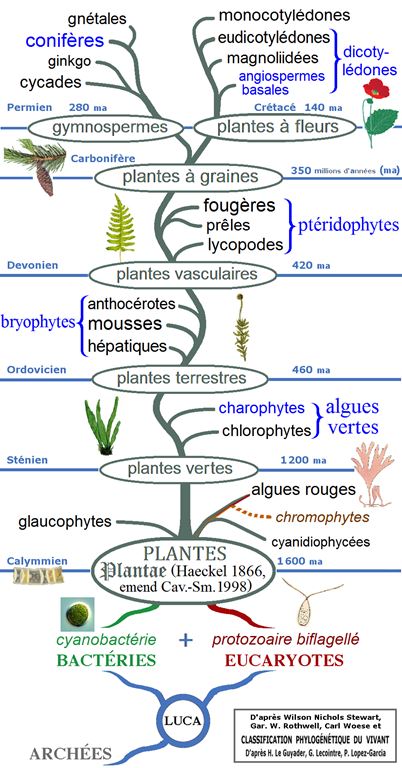
Classification
- Classique : en haut de l\'écran, sous le coeur.
- Phylogénétique :
- Clade 4 : Angiospermes ;
- Clade 3 : Dicotylédones_vraies ;
- Clade 2 : Astéridées ;
- Clade 1 : Lamiidées ;
- Ordre APN : Lamiales ;
- Famille APN : Acanthaceae ;
Illustration : cet arbre phylogénétique des plantes montre les principaux clades et groupes traditionnels (monophylétiques en noir et paraphylétiques en bleu).
Dénominations
✖- Nom botanique : Avicennia marina (Forsskal) Vierhapper
- Synonymes : Avicennia alba Wight, Sceura marina Forskal
- Noms anglais et locaux : White mangrove, Grey Mangrove
Description et culture
✖- dont infos de "FOOD PLANTS INTERNATIONAL" :
Description :
Un petit arbre atteignant 3-8 m de haut. Il s'étend sur 2 à 5 m de large. Il a souvent plusieurs tiges. Il a de nombreuses racines aérées minces. Ceux-ci sont minces comme un crayon et proviennent des racines rayonnantes sous la surface. L'écorce est lisse et grise à blanche. Les feuilles mesurent 3-8 cm de long sur 2-3 cm de large. Ils sont ovales en forme d'épée et gris-vert brillant. Ils sont coriaces et blanchâtres en dessous. Les feuilles se font face à l'une à l'autre. Les feuilles ont une courte tige. Les fleurs mesurent 0,5 cm de diamètre. Ils sont jaunâtres et ont un doux parfum. Ils se produisent à l'aisselle des feuilles. La capsule du fruit est aplatie et possède 2 grandes feuilles de graines. Le fruit est comestible. Il y a une graine à l'intérieur. La graine germe sur le buisson avant de tomber. Cette espèce varie beaucoup. Il existe quelques sous-espèces désignées{{{0(+x) (traduction automatique).
Original : A small tree up to 3-8 m high. It spreads to 2-5 m wide. It often has several stems. It has many slender aerating roots. These are pencil thin and arise from the radiating roots under the surface. The bark is smooth and grey to white. The leaves are 3-8 cm long by 2-3 cm wide. They are oval to sword shaped and shiny grey-green. They are leathery, and whitish underneath. The leaves occur opposite one another. The leaves have a short stalk. The flowers are 0.5 cm across. They are yellowish and have a sweet scent. The occur in the axils of leaves. The fruit capsule is flattened and has 2 large seed leaves. The fruit is edible. There is one seed inside. The seed germinates on the bush before it drops. This species varies a lot. There are some named subspecies{{{0(+x).
Production :
Les arbres en Australie fleurissent d'octobre à janvier et fructifient de janvier à février{{{0(+x) (traduction automatique).
Original : Trees in Australia flower from October to January and fruit January to February{{{0(+x).
Culture :
Les plantes sont souvent auto-semées. Les semis peuvent être transplantés{{{0(+x) (traduction automatique).
Original : Plants are often self sown. Seedlings can be transplanted{{{0(+x).
 Consommation (rapports de comestibilité, parties utilisables et usages alimentaires correspondants)
✖
Parties comestibles :
fruits, graines{{{0(+x) (traduction automatique).Original : Fruit, Seeds{{{0(+x).
Détails :
Les fruits sont consommés après la torréfaction. Ils sont largement trempés puis cuits. ATTENTION: Le jus amer est utilisé pour produire des avortements en Inde{{{0(+x) (traduction automatique).Original : The fruit are eaten after roasting. They are extensively soaked and then cooked. CAUTION: The bitter juice is used to produced abortions in India{{{0(+x).
Partie testée :
fruit{{{0(+x) (traduction automatique). Original : Fruit{{{0(+x)| Taux d'humidité | Énergie (kj) | Énergie (kcal) | Protéines (g) |
|---|---|---|---|
| / | / | / | / |
| Pro- vitamines A (µg) |
Vitamines C (mg) | Fer (mg) | Zinc (mg) |
| / | / | / | / |
 Risques et précautions à prendre
✖
néant, inconnus ou indéterminés.
Autres infos
✖dont infos de "FOOD PLANTS INTERNATIONAL" :
Distribution :
Une plante tropicale. Il pousse sous les tropiques mais s'étend également dans les régions plus froides. Ils se trouvent le plus souvent au bord de la mer des mangroves. Il pousse dans un sol boueux avec un pH de 6,5 à 8. Il ne tolère pas l'ombre. Il peut pousser dans les sols salés. Il peut pousser dans des endroits arides. Il convient aux zones de rusticité 10-12{{{0(+x) (traduction automatique).
Original : A tropical plant. It grows in the tropics but also extends into cooler regions. They are most commonly on the seaward edge of the mangroves. It grows in muddy soil with a pH of 6.5-8. It cannot tolerate shade. It can grow in salty soils. It can grow in arid places. It suits hardiness zones 10-12{{{0(+x).
Localisation :
Afrique, Amérique, Arabie, Asie, Australie, Bahreïn, Bangladesh, Chine, Comores, Afrique de l'Est, Timor oriental, Égypte, Inde, Indochine, Indonésie, Iran, Japon, Kenya, Madagascar, Maldives, Mozambique, Myanmar, Nouvelle-Calédonie, Nouvelle Nouvelle-Zélande, Afrique du Nord, Oman, Pacifique, Pakistan, Papouasie-Nouvelle-Guinée, PNG, Philippines, Qatar, Arabie saoudite, Asie du Sud-Est, Singapour, Îles Salomon, Afrique du Sud, Afrique australe, Sri Lanka, Soudan, Taïwan, Tanzanie, Thaïlande, Timor -Leste, Emirats Arabes Unis, EAU, Vietnam, Yémen{{{0(+x) (traduction automatique).
Original : Africa, America, Arabia, Asia, Australia, Bahrain, Bangladesh, China, Comoros, East Africa, East Timor, Egypt, India, Indochina, Indonesia, Iran, Japan, Kenya, Madagascar, Maldives, Mozambique, Myanmar, New Caledonia, New Zealand, North Africa, Oman, Pacific, Pakistan, Papua New Guinea, PNG, Philippines, Qatar, Saudi Arabia, SE Asia, Singapore, Solomon Islands, South Africa, Southern Africa, Sri Lanka, Sudan, Taiwan, Tanzania, Thailand, Timor-Leste, United Arab Emirates, UAE, Vietnam, Yemen{{{0(+x).
Notes :
Il existe environ 6 à 8 espèces d'Avicennia. Ils sont tropicaux. C'était dans les familles Avicenniaceae et Verbenaceae{{{0(+x) (traduction automatique).
Original : There are about 6-8 Avicennia species. They are tropical. It was in the Avicenniaceae and Verbenaceae families{{{0(+x).
Liens, sources et/ou références
✖Sources et/ou références :
dont livres et bases de données : 0"Food Plants International" (en anglais) ;
Recherche de/pour :
- "Avicennia marina" sur Google (pages et
images) ;
INPI (en anglais) ;
TROPICOS (en anglais) ;
Tela Botanica ;
Pl@ntNet ;
Pl@ntUse ;
- "Avicennia marina" sur Google (pages et
images) ;
INPI (en anglais) ;
TROPICOS (en anglais) ;
Tela Botanica ;
Pl@ntNet ;
Pl@ntUse ;
Sous-espèces, variétes...
✖1 taxons
Espèces du même genre (Avicennia)
✖5 taxons
Espèces de la même famille (Acanthaceae)
✖50 taxons (sur 180)
- Acanthopale aethiopica
- Acanthopale laxiflora (Lindau) C. B. Clarke
- Acanthus dioscoridis
- Acanthus ebracteatus
- Acanthus eminens
- Acanthus hirsutus
- Acanthus mollis L. (Acanthe à feuilles molles)
- Acanthus montanus T. Anders
- Acanthus polystachius
- Acanthus sennii Chiov.
- Adhatoda schimperiana
- Andrographis paniculata (Burm.f.) Nees (Chirette verte)
- Anisacanthus thurberi
- Anisotes trisulcus
- Asystasia buettneri
- Asystasia calycina
- Asystasia dalzelliana
- Asystasia gangetica
- Asystasia mysorensis
- Asystasia schimperi
- Asystasia vogeliana
- Asystasia zamboagenita
- Asystasiella neesiana
- Avicennia africana
- Avicennia alba
- Avicennia germinans
- Avicennia marina
- Avicennia officinalis
- Barleria acanthoides
- Barleria bornuensis
- Barleria brownii
- Barleria cristata
- Barleria eranthemoides
- Barleria grantii
- Barleria longissima
- Barleria opaca
- Barleria robentiana
- Barleria strigosa
- Barleria ventricosa
- Beloperone californica
- Blepharis ciliaris
- Blepharis edulis
- Blepharis linariifolia
- Blepharis maderaspatensis
- Brillantaisia madagascariensis
- Brillantaisia owariensis
- Brunoniella acaulis
- Brunoniella australis
- Clinacanthus nutans
- Crabbea nana
- ...







 pour les fleurs (et/ou pétales, calice...),
 pour les feuilles (et/ou la tige, les pousses...),
 pour les racines,
 pour le tronc (et/ou l'écorce, la sève...), et enfin
 pour les champignons,
puis les notes alimentaires et médicinales (de 1 à 5 étoiles), la rusticité (résistance au froid/gel)
et pour finir un résumé.
pour les champignons,
puis les notes alimentaires et médicinales (de 1 à 5 étoiles), la rusticité (résistance au froid/gel)
et pour finir un résumé. menant ici 🙂
 ,
,  et
et

 ,
,
 ,
,
 ,
,





 ,
,