
Laitue sauvage
(Lactuca serriola)


 |
**
-
***
|
**
-
***
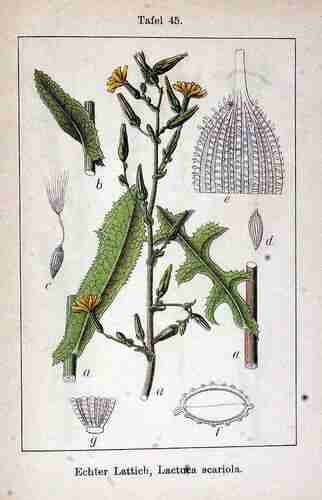
Une herbe. Elle atteint une hauteur de 1 à 2 m. Il faut 2 ans pour terminer son cycle de vie. Il a une racine pivotante bien développée. Les feuilles ont des lobes profonds ... (traduction automatique)
→suite


Laitue sauvage
Note alimentaire 
Note médicinale 

Une herbe. Elle atteint une hauteur de 1 à 2 m. Il faut 2 ans pour terminer son cycle de vie. Il a une racine pivotante bien développée. Les feuilles ont des lobes profonds et sont vert bleuâtre avec une floraison blanchâtre. Ils ont des bords épineux. Les feuilles inférieures forment un anneau près du sol. Ils... (traduction automatique) →suite
Pas d'autre illustration
pour le moment 😕
Classification
- Classique : en haut de l\'écran, sous le coeur.
- Phylogénétique :
- Clade 4 : Angiospermes ;
- Clade 3 : Dicotylédones_vraies ;
- Clade 2 : Astéridées ;
- Clade 1 : Campanulidées ;
- Ordre APN : Asterales ;
- Famille APN : Asteraceae ;
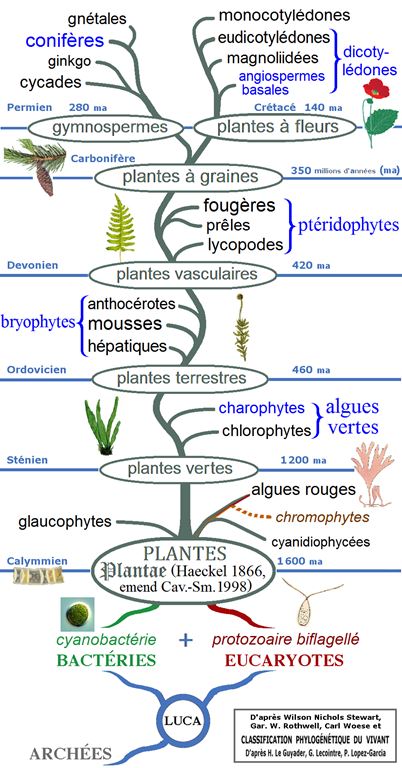
Illustration : cet arbre phylogénétique des plantes montre les principaux clades et groupes traditionnels (monophylétiques en noir et paraphylétiques en bleu).
Dénominations
✖- Nom botanique : Lactuca serriola L. (1753)
- Synonymes français : laitue scariole, laitue de Saint Joseph, doucette, Saint Joseph, laitue serriole, escarole, laitue scarole, scarole
- Synonymes : Lactuca altaica Fisch. & C. A. Mey, Lactuca augustana All, Lactuca coriacea Sch.Bip, Lactuca dubia Jord, Lactuca scariola L.Lactuca sylvestris Lam, Lactuca tephrocarpa K. Koch
- Noms anglais et locaux : compassplant (compass plant), milk thistle, prickly lettuce, scarole, khass el-baqar (ar), khass el-homar (ar), Kompass-Lattich (de), Stachellattich (de), wilder Lattich (de), alface-silvestre (pt), alface-de-espinho (pt,br), escarola (es), lechuga espinaca (es), taggsallat (sv)
Description et culture
✖Nombre de graines au gramme :
900/1100
- dont infos de "FOOD PLANTS INTERNATIONAL" :
Description :
Une herbe. Elle atteint une hauteur de 1 à 2 m. Il faut 2 ans pour terminer son cycle de vie. Il a une racine pivotante bien développée. Les feuilles ont des lobes profonds et sont vert bleuâtre avec une floraison blanchâtre. Ils ont des bords épineux. Les feuilles inférieures forment un anneau près du sol. Ils sont grands et les feuilles supérieures sont plus petites. Les feuilles mesurent 3 à 18 cm de long. La tige fleurie est raide et haute de 1,5 m. Les fleurs sont petites et jaunes. Il y a des piquants sur la nervure médiane des feuilles. Les tiges épineuses suintent de sève laiteuse lorsqu'elles sont coupées. La variété scariola a des feuilles et des lobes plus étroits que Lactuca serriola{{{0(+x) (traduction automatique).
Original : A herb. It grows 1-2 m high. It takes 2 years to complete its life-cyle. It has a well developed taproot. The leaves have deep lobes and are bluish-green with a whitish bloom. They have prickly edges. The lower leaves form a ring near the ground. They are large and the higher leaves are smaller. The leaves are 3-18 cm long. The flowering stem is stiff and 1.5 m high. The flowers are small and yellow. There are prickles on the midrib of the leaves. The spiny stems ooze milky sap when cut. Variety scariola has leaves and lobes that are more narrow than Lactuca serriola{{{0(+x).
 Consommation (rapports de comestibilité, parties utilisables et usages alimentaires correspondants)
✖
Feuille (jeunes, dont tiges épluchées)1 et racine (extrait (latex))1 comestibles.(1*)
Détails : Feuilles, graines - huile{{{0(+x).
Jeunes plantes consommées en salade{{{27(+x) ; les feuilles doivent être utilisées quand elles sont jeunes ; les feuilles sont utilisées comme légume ; elles peuvent être utilisées dans les salades ou cuites{{{0(+x) (ex. : comme potherbe(dp*)).
Les graines peuvent être utilisées pour produire de l'huile de cuisson comestible ; elle doit être raffinée avant consommation.
La laitue sauvage bouillie a un goût d'asperge{{{0(+x).(1*)
Partie testée :
feuilles - poids sec{{{0(+x) (traduction automatique). Original : Leaves - dry wt{{{0(+x)| Taux d'humidité | Énergie (kj) | Énergie (kcal) | Protéines (g) |
|---|---|---|---|
| / | / | / | 16.5 |
| Pro- vitamines A (µg) |
Vitamines C (mg) | Fer (mg) | Zinc (mg) |
| / | / | / | / |
Risques et précautions à prendre
✖
(1*)ATTENTION : la plante mature est légèrement toxiqueµ{{{5(+) ; elle accumule du lactucarium, au moment de la floraison, lequel est légèrement narcotique{{{0(+x) ; voir genre Lactuca, et fiche toxine pour plus d'informations{{{(rp*).
Galerie(s)
✖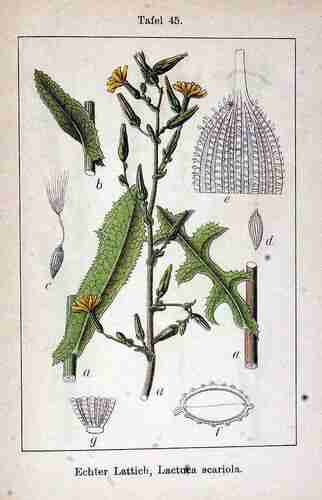
Par Krause E.H.L., Sturm J., Lutz K.G. (Flora von Deutschland in Abbildungen nach der Natur, Zweite auflage, vol. 14: t. 45, 1906), via plantillustrations.org
✖
Autres infos
✖dont infos de "FOOD PLANTS INTERNATIONAL" :
Distribution :
C'est une plante tempérée. Il pousse sur des terrains vagues et peut être sur des terres caillouteuses ou rocheuses et des dunes de sable. Il peut pousser dans des endroits arides. Dans l'ouest de la Chine, il pousse entre 500 et 2000 m d'altitude. Herbier de Tasmanie{{{0(+x) (traduction automatique).
Original : It is a temperate plant. It grows on waste ground and can be on stony or rocky land and sand dunes. It can grow in arid places. In western China it grows between 500-2,000 m above sea level. Tasmania Herbarium{{{0(+x).
Localisation :
Afghanistan, Afrique, Albanie, Argentine, Asie, Australie, Botswana, Brésil, Grande-Bretagne, Canada, Caucase, Chili, Chine, Crète, Croatie, Cuba, République dominicaine, Afrique de l'Est, Égypte, Europe *, France, Géorgie, Allemagne, Grèce Afrique du Sud, Inde, Iran, Irak, Italie, Kazakhstan, Kirghizistan, Liban, Méditerranée, Mongolie, Pays-Bas, Nouvelle-Zélande, Afrique du Nord, Amérique du Nord, Inde du Nord-Est, Pakistan, Paraguay, Portugal, Russie, Sicile, Amérique du Sud, Sud Afrique, Espagne, Soudan, Syrie, Taiwan, Tadjikistan, Tasmanie, Turquie, Uruguay, USA, Antilles, Zimbabwe{{{0(+x) (traduction automatique).
Original : Afghanistan, Africa, Albania, Argentina, Asia, Australia, Botswana, Brazil, Britain, Canada, Caucasus, Chile, China, Crete, Croatia, Cuba, Dominican Republic, East Africa, Egypt, Europe*, France, Georgia, Germany, Greece, India, Iran, Iraq, Italy, Kazakhstan, Kyrgyztsan, Lebanon, Mediterranean, Mongolia, Netherlands, New Zealand, North Africa, North America, Northeastern India, Pakistan, Paraguay, Portugal, Russia, Sicily, South Africa, South America, Southern Africa, Spain, Sudan, Syria, Taiwan, Tajikistan, Tasmania, Turkey, Uruguay, USA, West Indies, Zimbabwe{{{0(+x).
Notes :
Il existe environ 20 espèces de Lactuca. Il peut contenir des composés amers qui ont un effet sédatif{{{0(+x) (traduction automatique).
Original : There are about 20 Lactuca species. It can contain bitter compounds that have a sedative effect{{{0(+x).
Liens, sources et/ou références
✖Sources et/ou références :
Tela Botanica ; 5"Plants For A Future" (en anglais) ;
dont classification : "The Plant List" (en anglais) ; "GRIN" (en anglais) ;
dont livres et bases de données : 0"Food Plants International" (en anglais), 1Plantes sauvages comestibles (livre pages 154 et 155, par S.G. Fleischhauer, J. Guthmann et R. Spiegelberger), 27Dictionnaire des plantes comestibles (livre, page 169, par Louis Bubenicek) ;
Herbier gourmand (de Marc Veyrat et François Couplan, éditions Hachette, 1997) / détails du livre ; Plantes sauvages comestibles (de S.G. Fleischhauer, J. Guthmann et R. Spiegelberger, éditions Ulmer, 2012) / détails du livre ; Sauvages & comestibles - herbes, fleurs et petites salades (de Marie-Claude Paume, éditions EDISUB, 2011) / détails du livre
Recherche de/pour :
Espèces du même genre (Lactuca)
✖36 taxons
- Lactuca acanthifolia
- Lactuca aculeata
- Lactuca alpina
- Lactuca biennis
- Lactuca canadensis
- Lactuca capensis
- Lactuca carinata
- Lactuca debilis
- Lactuca denticulata
- Lactuca dissecta
- Lactuca dolichophylla
- Lactuca formosana
- Lactuca hookeri
- Lactuca indica
- Lactuca inermis
- Lactuca longidentata
- Lactuca ludoviciana
- Lactuca macrophylla (Willd.) A.Gray (Laitue à grandes feuilles)
- Lactuca orientalis
- Lactuca perennis L. (Laitue vivace)
- Lactuca plumieri (L.) Gren. & Godr. (Laitue de plumier)
- Lactuca pulchella
- Lactuca quercina L. (Laitue à feuilles de chêne)
- Lactuca raddeana
- Lactuca ramosissima (All.) Gren. & Godr. (Laitue très ramifiée)
- Lactuca saligna L. (Laitue à feuilles de saule)
- Lactuca sativa L. (Laitue)
- Lactuca schweinfurthii
- Lactuca serriola L. (Laitue sauvage)
- Lactuca sibirica
- Lactuca tatarica
- Lactuca tenerrima Pourr. (Laitue délicate)
- Lactuca triangulata
- Lactuca tuberosa
- Lactuca viminea (L.) J.Presl & C.Presl (Laitue des vignes)
- Lactuca virosa L. (Laitue vireuse)
Espèces de la même famille (Asteraceae)
✖50 taxons (sur 1404)
- Aaronsohnia pubescens
- Aarosohnia factorovskyi
- Acanthospermum hispidum DC.
- Achillea ageratum L.
- Achillea alpinaa
- Achillea arabica
- Achillea atrata L.
- Achillea borealis
- Achillea clavennae L.
- Achillea clypeolata
- Achillea coarctata
- Achillea decolorans Schrad. ex Willd.
- Achillea erba-rotta
- Achillea filipendulina Lam.
- Achillea ligustica
- Achillea millefolium L. (Achillée millefeuille)
- Achillea nana L.
- Achillea nobilis L.
- Achillea ptarmica L. (Achillée ptarmique)
- Achillea sibirica Ledeb.
- Achillea tenuifolia
- Achillea teretifolia Willd.
- Achillea vermicularis
- Achyrachaena mollis Schauer
- Achyrocline alata
- Achyrocline satureioides (Lam.) DC.
- Acilepis aspera
- Acmella alba (L'Hér.) R.K.Jansen
- Acmella brachyglossa Cass.
- Acmella calva
- Acmella caulirhiza Delile
- Acmella ciliata (Kunth) Cass.
- Acmella decumbens
- Acmella oleracea (L.) R.K. Jansen (Brède mafane)
- Acmella oppositifolia (Lam.) R.K.Jansen
- Acmella paniculata (Wall. ex DC.) R.K.Jansen
- Acmella uliginosa (Sw.) Cass.
- Acnistus arborescens (L.) Schltdl.
- Actinella odorata
- Adenocaulon himalaicum
- Adenostemma lavenia
- Adenostemma viscosum
- Adenostoma sparsifolium
- Aetheorhiza bulbosa
- Ageratina adenophora
- Ageratina aromatica
- Ageratina sternbergiana
- Agoseris aurantiaca
- Agoseris glauca
- Agoseris villosa
- ...








 pour le fruit (et/ou les graines, la pulpe, etc...),
 pour les fleurs (et/ou pétales, calice...),
 pour le tronc (et/ou l'écorce, la sève...), et enfin
 pour les champignons,
puis les notes alimentaires et médicinales (de 1 à 5 étoiles), la rusticité (résistance au froid/gel)
et pour finir un résumé.
pour les champignons,
puis les notes alimentaires et médicinales (de 1 à 5 étoiles), la rusticité (résistance au froid/gel)
et pour finir un résumé. menant ici 🙂
 ,
,  et
et

 ,
,
 ,
,
 ,
,





 ,
,