Myrianthus arboreus
 |
****
-
***
|
****
-
***
Un arbre de taille moyenne. Il atteint 15-25 m de haut. Il se ramifie bas. La couronne est dense. Les feuilles sont composées de folioles disposées comme des doigts sur une ... (traduction automatique)
→suite


Myrianthus arboreus
Note alimentaire 
Note médicinale 

Un arbre de taille moyenne. Il atteint 15-25 m de haut. Il se ramifie bas. La couronne est dense. Les feuilles sont composées de folioles disposées comme des doigts sur une main. Il y a 5 à 7 dépliants... (traduction automatique) →suite
Classification
- Classique : en haut de l'écran, sous le coeur.
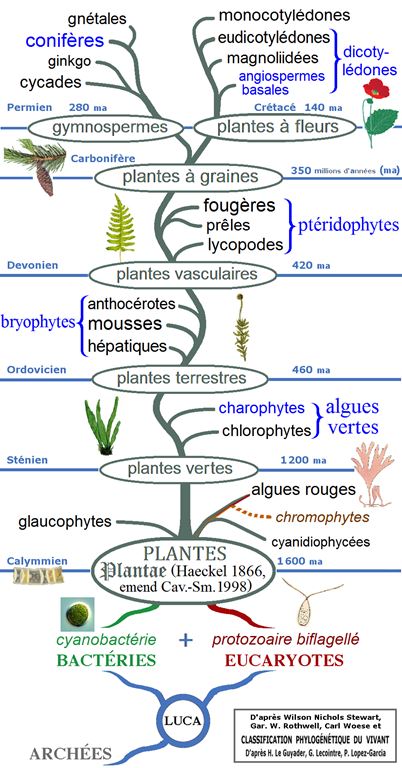
- Phylogénétique :
- Clade 4 : Angiospermes ;
- Clade 3 : Dicotylédones_vraies ;
- Clade 2 : Rosidées ;
- Clade 1 : Fabidées ;
- Ordre APN : Rosales ;
- Famille APN : Urticaceae ;
À droite, cet arbre phylogénétique des plantes montre les principaux clades et groupes traditionnels (monophylétiques en noir et paraphylétiques en bleu).
Dénominations
- Nom botanique : Myrianthus arboreus P.Beauv.
- Noms anglais et locaux : Giant yellow mulberry, Monkeyfruit
Description et culture
Tableau récapitulatif
Parties comes-tibles Note comest. (1-5) Note medic. (1-5) (Zones de) Rusticité Besoins en 
Besoins en  (1-3)
(1-3)Périodes de semis et récoltes Graines au gramme Durée de viabilité Profon-deur semis Espace-ment plants Espace-ment lignes Durée germi-native Durée avant récolte J F M A M J
J A S O N D
J F M A M J
J A S O N D
- dont infos de 0FPI ("FOOD PLANTS INTERNATIONAL", en anglais) :
Description :
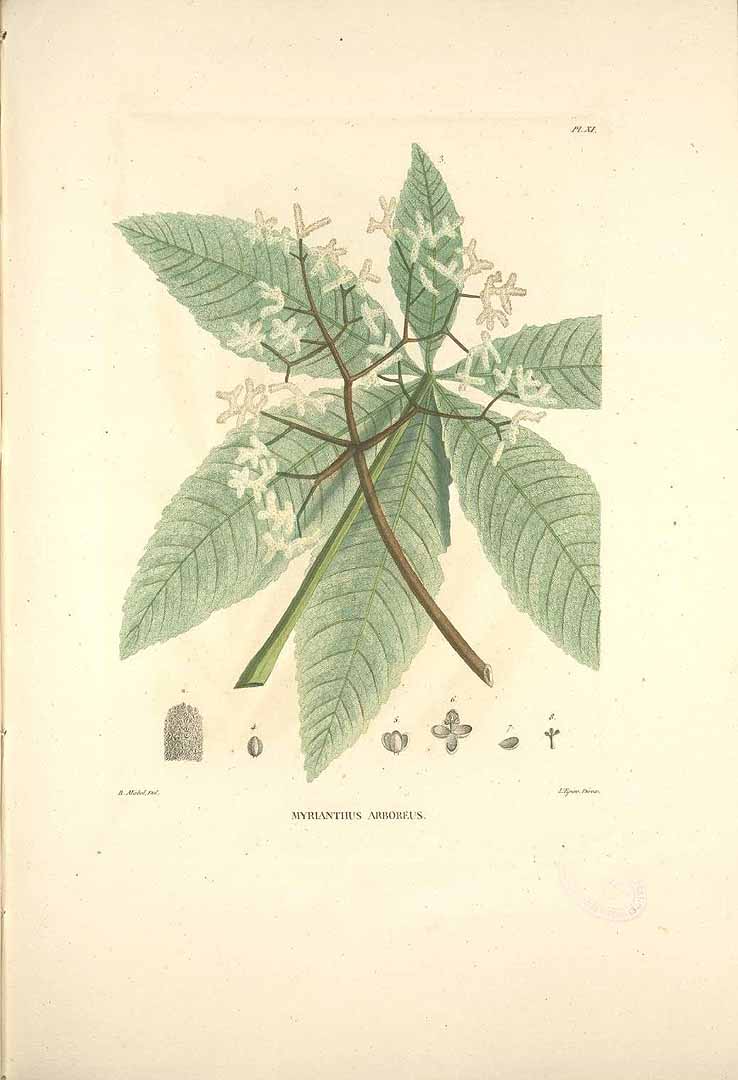
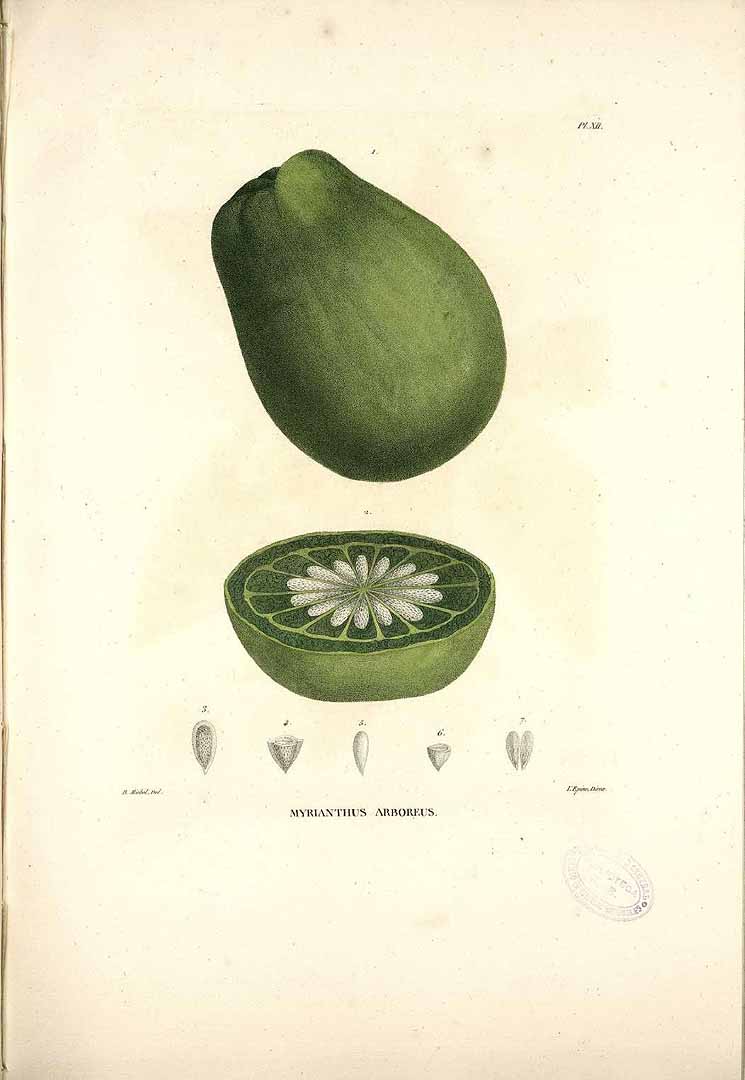
Un arbre de taille moyenne. Il atteint 15-25 m de haut. Il se ramifie bas. La couronne est dense. Les feuilles sont composées de folioles disposées comme des doigts sur une main. Il y a 5 à 7 dépliants. Les feuilles mesurent 90 cm de long et 60 cm de diamètre. Ils sont coriaces et blanchâtres en dessous. Il peut y avoir des dents le long du bord. Les fleurs mâles et femelles sont séparées. Les fleurs mâles sont en longues tiges et sont jaunes. Les fleurs femelles sont en petites boules. Les fruits sont gros et jaunes. Ils ont des sections de 4 ou 5 côtés. Les fruits peuvent mesurer 20 cm de diamètre. Chaque section contient une graine ovale dure{{{0(+x) (traduction automatique).
Original : A medium sized tree. It grows 15-25 m tall. It branches low down. The crown is dense. The leaves are compound with leaflets arranged like fingers on a hand. There are 5-7 leaflets. Leaves are 90 cm long and 60 cm across. They are leathery and are whitish underneath. There can be teeth along the edge. The male and female flowers are separate. The male flowers are in long stalks and are yellow. The female flowers are in small balls. The fruit are large and yellow. They have 4 or 5 sided sections. Fruit can be 20 cm across. Each sections contains a hard oval seed{{{0(+x).
Production :
Les plantes issues de graines peuvent produire des fruits en 4 à 5 ans. Dans certains endroits, la fructification est saisonnière et dans d'autres endroits, elle a lieu toute l'année. Les feuilles peuvent rester fraîches pendant 3 à 5 jours après la récolte. Il y a un afflux de feuilles comestibles pendant la saison sèche{{{0(+x) (traduction automatique).
Original : Plants from seed can produce fruit in 4-5 years. In some places fruiting is seasonal and in other places it is year round. Leaves can remain fresh for 3-5 days after harvesting. There is a flush of edible leaves during the dry season{{{0(+x).
Culture :
Les plantes sont cultivées à partir de graines. Les graines mettent environ 1 mois à germer. Le trempage des graines aide davantage à germer. Les plantes peuvent être cultivées à partir de boutures et par greffage. Les plantes peuvent être bourgeons. Les plantes peuvent être cultivées à partir de boutures de tige{{{0(+x) (traduction automatique).
Original : Plants are grown from seed. Seeds take about 1 month to germinate. Soaking seeds helps more to germinate. Plants can be grown from cuttings and by grafting. Plants can be budded. Plants can be grown from stem cuttings{{{0(+x).
 Consommation (rapports de comestibilité, parties utilisables et usages alimentaires correspondants)
Consommation (rapports de comestibilité, parties utilisables et usages alimentaires correspondants)Noyau sec/séché{{{0(+x).
Partie testée :
noyau séché{{{0(+x) (traduction automatique). Original : Kernel dried{{{0(+x)| Taux d'humidité (%) | Énergie (kj) | Énergie (kcal) | Protéines (g) |
|---|---|---|---|
| 13.5 | 1969 | 471 | 23.6 |
| Pro- vitamines A (µg) |
Vitamines C (mg) | Fer (mg) | Zinc (mg) |
| 0 | 0 | 6.6 | 0 |
 Risques et précautions à prendre
Risques et précautions à prendrenéant, inconnus ou indéterminés.
Galerie(s)
Par Palisot de Beauvois, A.M.F.J., Flore d?Oware et de Benin en Afrique (1804-1807) Fl. Oware vol. 1 t. 12, via plantillustrations
✖

Par Palisot de Beauvois, A.M.F.J., Flore d?Oware et de Benin en Afrique (1804-1807) Fl. Oware vol. 1 t. 11, via plantillustrations
✖


Par Engler, H.G.A., Monographien afrikanischer Pflanzen-Familien und -Gattungen (1898-1904) Monogr. Afrik. Pflanzen-Fam. vol. 1 (1898) t. 16, via plantillustrations
✖
Autres infos
dont infos de 0FPI ("FOOD PLANTS INTERNATIONAL", en anglais) :
Statut :
C'est le légume indigène le plus populaire dans certaines régions. Les feuilles sont vendues sur les marchés locaux. Les fruits sont populaires{{{0(+x) (traduction automatique).
Original : It is the most popular indigenous vegetable in some regions. Leaves are sold in local markets. The fruit are popular{{{0(+x).
Distribution :
Une plante tropicale. Il pousse le long des lisières des forêts tropicales. Il est souvent près des ruisseaux et dans des endroits humides. Il pousse jusqu'à 1 200 m d'altitude mais est le plus commun en dessous de 300 m{{{0(+x) (traduction automatique).
Original : A tropical plant. It grows along the edges of rain-forests. It is often near streams and in moist locations. It grows up to 1,200 m altitude but is most common below 300 m{{{0(+x).
Localisation :
Afrique, Angola, Bénin, Cameroun, Centrafrique, République centrafricaine, RCA, RD Congo, Congo R, Côte d'Ivoire, Afrique de l'Est, Ethiopie, Guinée équatoriale, Gabon, Ghana, Guinée, Guinée, Ivoire Côte, Kenya, Libéria, Malawi, Mozambique, Nigéria, Sierra Leone, Sud-Soudan, Soudan, Tanzanie, Togo, Ouganda, Afrique de l'Ouest{{{0(+x) (traduction automatique).
Original : Africa, Angola, Benin, Cameroon, Central Africa, Central African Republic, CAR, Congo DR, Congo R, Côte d'Ivoire, East Africa, Ethiopia, Equatorial-Guinea, Gabon, Ghana, Guinea, Guinée, Ivory Coast, Kenya, Liberia, Malawi, Mozambique, Nigeria, Sierra Leone, Southern Sudan, Sudan, Tanzania, Togo, Uganda, West Africa{{{0(+x).
Notes :
Il existe 7 espèces de Myrianthus. Ils poussent en Afrique tropicale. Il fournit de la nourriture pendant la période de famine avant la récolte d'autres nouvelles cultures{{{0(+x) (traduction automatique).
Original : There are 7 Myrianthus species. They grow in tropical Africa. It provides food during the hungry period before other new crops are harvested{{{0(+x).
Liens, sources et/ou références
Liens :
/ ;Sources et/ou références :
bibliographie (liste des sources et/ou références de l'encyclopédie)
dont classification : IPNI ("International Plant Names Index", en anglais) ; Kew (POWO - "Plant Of the World Online", "Royal Botanical Garden", en anglais) ;
dont livres et bases de données : 5PFAF ("Plants For A Future", en anglais) ; 0FPI ("FOOD PLANTS INTERNATIONAL", en anglais) ;
dont bibliographie/références de 0FPI ("FOOD PLANTS INTERNATIONAL", en anglais) :
Abbiw, D.K., 1990, Useful Plants of Ghana. West African uses of wild and cultivated plants. Intermediate Technology Publications and the Royal Botanic Gardens, Kew. p 42 ; Aniama, S. O., et al, 2016, Ethnobotanical documentaton of some plants among Igala people of Kogi State (Nigeria). The International Journal Of Engineering And Science (IJES). 5(4) pp 33-42 ; Atato, A., et al, 2010, Diversity of Edible Wild Fruit Tree Species of Togo. Global Science Books. ; Boateng, S. K., et al, 2007, Wet Season of Edible Wild Fruits in Three Regions of Ghana. Journal of Plant Sciences 2(3): 353-357 ; Burkill, H. M., 1985, The useful plants of west tropical Africa, Vol. 1. Kew. ; Codjia, J. T. C., et al, 2003, Diversity and local valorisation of vegetal edible products in Benin. Cahiers Agricultures 12:1-12 ; Dalziel, J. M., 1937, The Useful plants of west tropical Africa. Crown Agents for the Colonies London. ; Danforth, R.M., & Boren, P.D., 1997, Congo Native fruits. Twenty-five of the best. Privately published. p 41 ; Davis, S.D., Heywood, V.H., & Hamilton, A.C. (eds), 1994, Centres of plant Diversity. WWF. Vol 1. p 165, 244, ; Facciola, S., 1998, Cornucopia 2: a Source Book of Edible Plants. Kampong Publications, p 75 ; FAO. 1983, Food and fruit-bearing forest species 1: Examples from Eastern Africa. FAO Food and Forestry Paper 44/1 p 67 ; Fleuret, 1979, ; Grivetti, L. E., 1980, Agricultural development: present and potential role of edible wild plants. Part 2: Sub-Saharan Africa, Report to the Department of State Agency for International Development. p 50, 66 ; Grubben, G. J. H. and Denton, O. A. (eds), 2004, Plant Resources of Tropical Africa 2. Vegetables. PROTA, Wageningen, Netherlands. p 399 ; http://aflora.africa.kyoto-u.ac.jp ; INFOODSUpdatedFGU-list.xls ; Jardin, C., 1970, List of Foods Used In Africa, FAO Nutrition Information Document Series No 2.p 35, 91, 149 ; Kuhnlein, H. V., et al, 2009, Indigenous Peoples' food systems. FAO Rome p 262 ; Latham, P., 2004, Useful Plants of Bas-Congo province. Salvation Army & DFID p 200 ; Latham, P & Mbuta, A., 2017, Useful Plants of Central Province, Democratic Republic of Congo. Volume 2. Salvation Army p 56 ; Lautenschläger, T., et al, 2018, First large-scale ethnobotanical survey in the province of UÃge, northern Angola. Journal of Ethnobiology and Ethnomedicine (2018) 14:51 ; Liengola, I. B., 2001, A contribution to the study of native edible plants by the Turumbu and Lokele of the Tshopo District, Province Orientale, D. R. Congo. Syst. Geogr. Pl. 71:687-698 ; Lovett, J. C. et al, Field Guide to the Moist Forest Trees of Tanzania. p 34 ; Martin, F.W. & Ruberte, R.M., 1979, Edible Leaves of the Tropics. Antillian College Press, Mayaguez, Puerto Rico. p 206 ; Maundu, P. et al, 1999, Traditional Food Plants of Kenya. National Museum of Kenya. 288p ; Meregini, O. A., 2005, Some endangered plants producing edible fruits and seeds in Southeastern Nigeria. Fruits, Vol. 60 pp 211-220 ; Mosango, M., Szafranski, F., 1985, Plantes sauvages à fruits comestibles dans les environs de Kisangani (Zaïre). In: Journal d'agriculture traditionnelle et de botanique appliquée, 32e année, pp. 177-190 ; Moutsambote, J., 1996, Vegetation forestiere et plantes alimentaires de la region de la Sangha. Chp. 11 of Bien Manger et Bien Vivre. ORSTOM p 119 ; Msola, D. K., 2007, The role of Wild Foods in Household Income and Food Security in Mufundi District, Tanzania. Morogoro, Tanzania. p 44 ; Msuya, T. S., et al, 2010, Availability, Preference and Consumption of Indigenous Foods in the Eastern Arc Mountains, Tanzania, Ecology of Food and Nutrition, 49:3, 208-227 ; Nkeoua, G. & Boundzanga, G. C., 1999, Donnees sur les produits forestieres non ligneux en Republique du Congo. FAO. p 31 ; Okafor, J. C., 1978, Development of Forest Tree crops for Food Supplies in Nigeria. Forest Ecology and Management 1:235-247 ; Okafor, J.C., 2004. Myrianthus arboreus P.Beauv. [Internet] Record from Protabase. Grubben, G.J.H. & Denton, O.A. (Editors). PROTA (Plant Resources of Tropical Africa), Wageningen, Netherlands. < http://database.prota.org/search.htm>. Accessed 20 October 200919 October 2009. ; Okigbo, B.N., Vegetables in Tropical Africa, in Opena, R.T. & Kyomo, M.L., 1990, Vegetable Research and development in SADCC countries. Asian Vegetable Research and development Centre. Taiwan. p 44 ; Peters, C. R., O'Brien, E. M., and Drummond, R.B., 1992, Edible Wild plants of Sub-saharan Africa. Kew. p 79 ; Ruffo, C. K., Birnie, A. & Tengnas, B., 2002, Edible Wild Plants of Tanzania. RELMA p 482 ; Tanaka, ; Terashima, H., & Ichikawa, M., 2003, A comparative ethnobotany of the Mbuti and Efe hunter-gatherers in the Ituri Forest, Democratic Republic of Congo. African Study Monographs, 24 (1, 2): 1-168, March 2003 ; Termote, C., et al, 2011, Eating from the wild: Turumbu, Mbole and Bali traditional knowledge of non-cultivated edible plants, District Tshopo, DRCongo, Gen Resourc Crop Evol. 58:585-618 ; Termote, C., et al, 2012, Wild Edible Plant Markets in Kisangani, Democratic Republic of Congo. Human Ecology 40:269-285 ; Vivien, J., & Faure, J.J., 1996, Fruitiers Sauvages d'Afrique. Especes du Cameroun. CTA p 105 ; von Katja Rembold, 2011, Conservation status of the vascular plants in East African rain forests. Dissertation Universitat Koblenz-Landau p 174 ; www.worldagroforestrycentre.org/treedb/
Recherche de/pour :
- "Myrianthus arboreus" sur Google (pages et
images) ;
TPL ("The Plant List", en anglais) ;
GRIN ("Germplasm Resources Information Network", en anglais) ;
TROPICOS (en anglais) ;
Tela Botanica ;
Pl@ntNet ;
Pl@ntUse ;
"Useful Tropical Plants" (en anglais) ou
"Useful Temperate Plants" (en anglais) ;
- "Myrianthus arboreus" sur Google (pages et
images) ;
TPL ("The Plant List", en anglais) ;
GRIN ("Germplasm Resources Information Network", en anglais) ;
TROPICOS (en anglais) ;
Tela Botanica ;
Pl@ntNet ;
Pl@ntUse ;
"Useful Tropical Plants" (en anglais) ou
"Useful Temperate Plants" (en anglais) ;
Espèces du même genre (Myrianthus)
5 taxons
Espèces de la même famille (Urticaceae)
222 taxons
- Aiko
- Arbre à raisin
- Bhmère à fleurs pendantes
- Bhmère à grandes feuilles
- Mamaki
- Ortie
- Ortie à pilules
- Ortie douteuse
- Parasolier
- Pariétaire diffuse
- Pariétaire grêle
- Pariétaire officinale
- Petite ortie
- Pilée à petites feuilles
- Procride pédonculée
- Ramie
- Zouti rouge
- Boehmeria caudata Poir.
- Boehmeria glomerulifera Miq.
- Boehmeria japonica (L.f.) Miq.
- Boehmeria longispica Steud.
- Boehmeria macrophylla Hornem. (Bhmère à grandes feuilles)
- Boehmeria nipononivea Koidz.
- Boehmeria nivea (L.) Gaudich. (Ramie)
- Boehmeria penduliflora Wedd. ex D.G.Long (Bhmère à fleurs pendantes)
- Boehmeria rugulosa Wedd.
- Boehmeria spicata
- Boehmeria ternifolia D.Don
- Boehmeria tricuspis
- Cecropia angulata I.W.Bailey
- Cecropia angustifolia Trcul
- Cecropia concolor Miq.
- Cecropia distachya Huber
- Cecropia filicifolia
- Cecropia glaziovi
- Cecropia hololeuca Miq.
- Cecropia insignis Liebm.
- Cecropia latiloba Miq.
- Cecropia membranacea Trcul
- Cecropia montana Warb. ex Snethl.
- Cecropia obtusifolia Bertol.
- Cecropia pachystachya Trcul
- Cecropia palmata Willd.
- Cecropia peltata Vell.
- Cecropia pittieri B.L.Rob. ex A.Stewart
- Cecropia polystachya Trcul
- Cecropia purpurascens C.C.Berg
- Cecropia saxatilis Snethl.
- Cecropia sciadophylla Mart.
- Coussapoa asperifolia Trcul
- Coussapoa brevipes Pittier
- Coussapoa duguei
- Coussapoa microcarpa (Schott) Rizzini
- Coussapoa nitida Miq.
- Coussapoa schunkei Standl.
- Cypholophus nummularis H.J.P.Winkl.
- Debregeasia edulis
- Debregeasia hypoleuca
- Debregeasia longifolia (Burm.f.) Wedd.
- Debregeasia orientalis C.J.Chen
- Debregeasia saeneb (Forssk.) Hepper & J.R.I.Wood
- Debregeasia wallichiana Wedd.
- Dendrocnide basirotunda (C.Y.Wu) Chew
- Dendrocnide excelsa (Wedd.) Chew
- Dendrocnide longifolia (Hemsl.) Chew
- Dendrocnide moroides (Wedd.) Chew
- Dendrocnide photinophylla
- ...
Par Palisot de Beauvois, A.M.F.J., Flore d?Oware et de Benin en Afrique (1804-1807) Fl. Oware vol. 1 t. 11, via plantillustrations







 donne accès au menu
  - encyclopédies des plantes alimentaires ;
 - page de recherche - reconnaissance (identification) de plantes ;
 - page du calendrier lunaire et son générateur (au format PDF et JPG) ;
 - tableau récapitulatif ;
 - générateur de potées (soupes), avec estimation des apports nutrionnels et du coût;
 - générateur de codes QR ;
 - page des archives avec de nombreux documents sur différents thèmes complémentaires comme la botanique, les légumes,
les champignons, la cuisine, le bien-être ainsi que différents MOOC mais également des liens vers les archives de l'association ;
- page des archives avec de nombreux documents sur différents thèmes complémentaires comme la botanique, les légumes,
les champignons, la cuisine, le bien-être ainsi que différents MOOC mais également des liens vers les archives de l'association ;

 pour le fruit (et/ou les graines, la pulpe, etc...),
 pour les fleurs (et/ou pétales, calice...),
 pour les feuilles (et/ou la tige, les pousses...),
 pour les racines,
 pour le tronc (et/ou l'écorce, la sève...), et enfin
 pour les champignons,
puis les notes alimentaires et médicinales (de 1 à 5 étoiles), la rusticité (résistance au froid/gel)
et pour finir un résumé.
pour les champignons,
puis les notes alimentaires et médicinales (de 1 à 5 étoiles), la rusticité (résistance au froid/gel)
et pour finir un résumé. menant ici 🙂
 ,
,  et
et





 ,
,


 Encyclopédie(s)
 Recherche-Reconnaissance
 Tableau récapitulatif
 Codes QR
 Archives
 Calendrier(s) lunaire(s)
  Potées
 Re-naturation/naturalisation
 Affichettes, herbiers &
co.
Affichettes, herbiers &
co. menu
menu galerie


 (en bas à droite).
 (en bas à gauche).
